
A Royalty Rerate
Looking at a royalty play with catalysts

In my last piece (“Capturing the Arb”) I wrote about a company (South32) that has undergone a major portfolio transformation and how despite now offering investors clean exposure to future facing commodities in tier 1 jurisdictions it was yet to reprice to anything close to its (new) peers. This piece looks at a very similar story only in the royalty and streaming space… and there’s surprisingly quite a few links back to South32 as you’ll see.
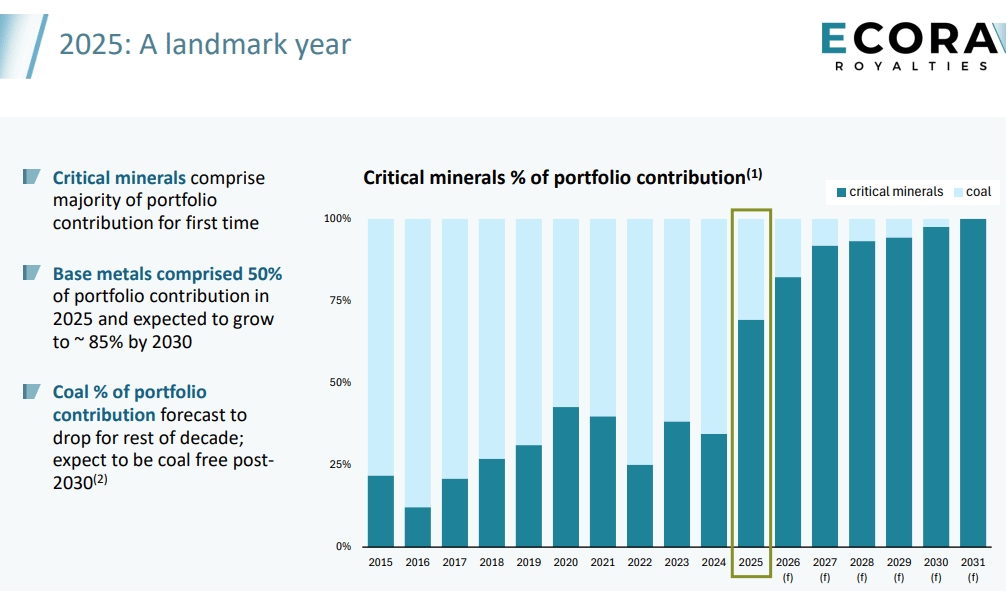
Ecora Royalties is a London listed royalty company with a portfolio of projects - predominantly royalties and streams on base metals projects in Western jurisdictions. The base metals focus is somewhat unusual in the royalty and streaming space where the vast majority of players are focused solely on precious metals. Even more unusual is how the current edition of the company came to be. Ecora, or Anglo Pacific as it was known back then started as an investment vehicle way back in the 90’s before stumbling onto some Australian coal royalties which it fed off for the best part of the 2000’s and 2010’s. Around ~7years ago with the coal royalties beginning to deplete and the investment landscape changing - the company shifted focus executing on a number of transformational critical mineral royalty acquisitions, some coal royalty sales and a company name change.
Why royalties?
There’s a few big themes playing out around the world right now. Sovereigns are rearming, reindustrialising and decarbonising (aka electrifying). These are all extremely expensive endeavours, commodity intensive, and for a large part are being funded by the money printer. The writing is on the wall in my opinion of a period of relentless inflation.
Inflation may be even more pronounced in the extractive industries space as you not only have input price rises to deal with but you have to deal with rapidly deteriorating geology and a rapidly depleting pool of skilled labour. It will take more inputs to get the same outputs. The sector has been starved of capital for the best part of 15 years and solving for labour and geological scarcity is going to take significant amounts of time and capital… or a technological breakthrough/miracle.
If you go back and analyse the returns in the mining sector during the last boom from the early 2000’s to around 2012 you’ll notice miners margins exploded with commodity prices in the early 2000’s but from the late 2000’s margins stalled despite commodity prices continuing their strong ascent.. as the cost line grew just as quickly as the revenue line.
Royalties are inflation protected securities… if you believe commodities hold their value in real terms as they have shown to over time. You get exposure to the revenue line on the miners P&L without getting exposure to the cost (or capex/depreciation) line.
Royalties also have an added advantage over miners in that they typically shelter you from excessive government take. You see when miners start to make money not only is it employees and contractors that stick their hands out for increased pay but the government do this and typically they do this far more aggressively.
In the aftermath of the start of the Russia/Ukraine conflict that saw energy prices skyrocket in early 2022 (oil, gas, coal).. we saw my home state of Queensland, Australia bump the royalty on coal extraction (a key part of the local economy) up to as much as 40% of revenue versus the old 15% (more on that later as Ecora was a beneficiary). We also saw the UK bring in egregious windfall profit taxes to the oil and gas sector where the effective tax rate was 78% tax rate. And more recently with the run up in gold prices we have seen a whole host of countries in West Africa - where gold mining is a big part of the economy - lift royalty rates significantly.. including mining friendly jurisdictions like Ghana and Cote d’Ivoire.
Governments are throwing money around like confetti, there is no fiscal restraint... And the most politically acceptable way to finance their spend is either via the money printer OR from taking from those who generate a decent profit and redistributing it back to the government (who runs at huge losses). Royalties protect you from stupidity and greed (aka governments).
Why base metals?
Those big themes - rearming, reindustrialising and decarbonising (aka electrification via EVs & “renewables”) all require huge amounts of industrial metals like copper.
And industrial metals like copper are coming from increasingly old mines. Over half of the worlds copper is from large porphyry mines over 30 years old.. the ore is getting deeper, harder and the grades are declining. To open a new porphyry takes decades of exploration, engineering and construction. With labour shortages, water shortages and stricter community and environmental standards this timeline is only getting longer.
Given the capital intensity of these projects and timeline to positive cash flow… you need a low cost of capital to build these mines. And if you believe the estimates someone like Robert Friedland throws out there on the number of copper mines that need to be developed over the coming decades… then the pool of capital required will need to be gigantic.. and the opportunity for royalty players to do accretive deals taking advantage of that cost of capital arbitrage is enormous.
If you can borrow in fiat at a rate below the rate of true inflation as these large royalty companies can and collect a royalty or stream linked to the price of industrial metals which grows at a rate above that of broader inflation… then you are capturing a huge value arbitrage.
Why Ecora, why now?
As I mentioned at the top Ecora is one of very few players in the royalty and streaming space that are focused on the industrial minerals space.. so there’s not all that much competition (there’s Altius and then there’s???).
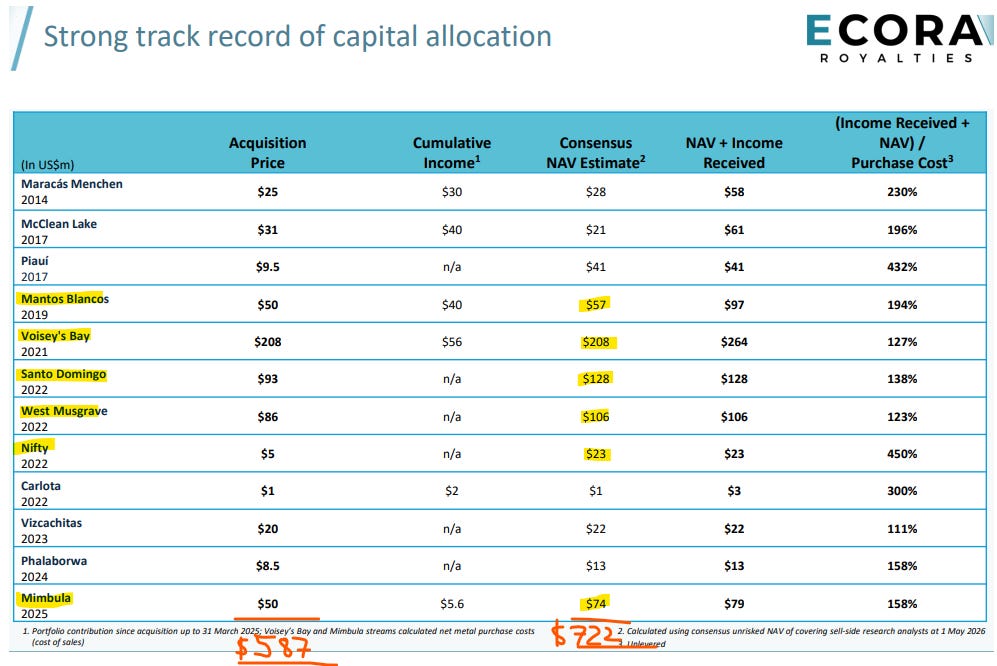
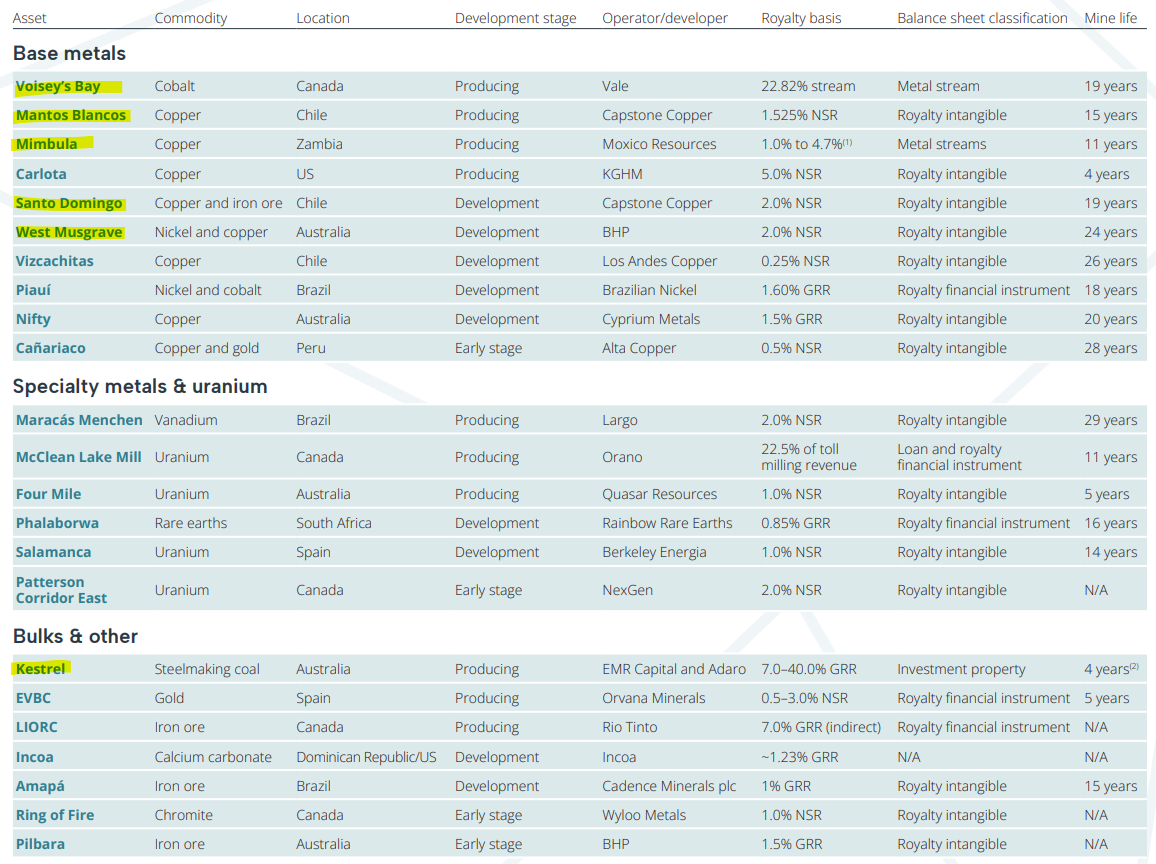
Today, Ecora can be acquired for an enterprise value of less than US$600 million - close to the cumulative acquisition cost of the royalty portfolio shown below which excludes existing assets such as Kestrel, Four Mile and Patterson Corridor East. It also sits well below my own valuation, particularly when factoring in current copper prices and the broad range of potential value catalysts the company has in front of it.
Let’s take a quick look at the key royalties (highlighted in yellow) and also explain what some of these near term catalysts are…
Coal Royalties (what remains)
It would be remiss to not talk about the coal royalties or what is left of them given they have got Ecora to the position they are in today.
In the early 2000’s Ecora stumbled across a private land royalty which sat on areas of two neighbouring metallurgical coal mines - Rio Tinto’s Kestrel mine and BHP’s Crinum mine (now owned by Yancoal and Sojitz respectively). And it’s been this royalty that has been the foundation of the company (Ecora also had a brief time holding a royalty on Whitehaven’s Narrabri mine before selling this back to the company in 2021).
The royalty Ecora holds mirrors the Queensland statutory rate and entitles Ecora from anywhere from 7%-40% of revenue depending on prevailing coal prices. So Ecora was a major beneficiary when the QLD government changed the royalty rates from 1 July 2022.. in that year alone Kestrel brought in US$107m in royalty income (with only the second half under the new regime).
Today all that remains left of the coal royalty portfolio is the very small slither of land shown below at Kestrel. I estimate that around 2mt of coal remains to be mined on the private royalty land, 1mt in 2H26 and the other 1mt (in the red box) spaced out over 2027-2030.
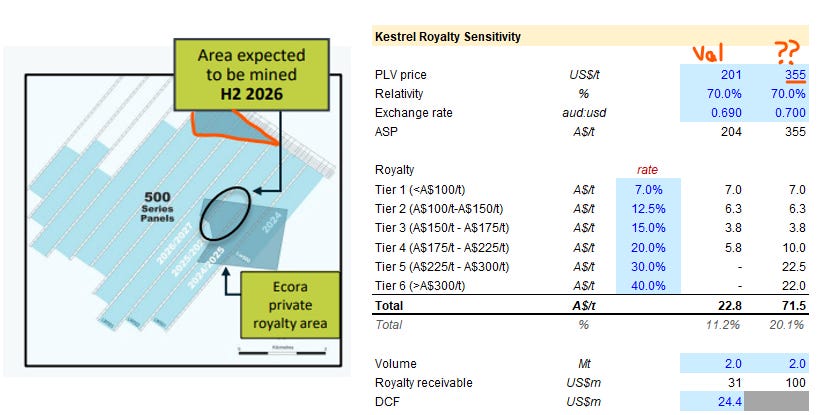
The company had an independent valuation on the royalty conducted at US$24.4m at the end of 2025 (refer note 14 of the accounts). The key assumptions being a benchmark coal price of US$201/t, 69c FX rate and an 11% discount rate.
Just note here - and I have shown above - that the royalty is very sensitive to price given the scaling nature where anything over A$300/t (US$210/t) has a royalty of 40%. So there is big upside skew here to what remains of this royalty.
Mantos Blancos
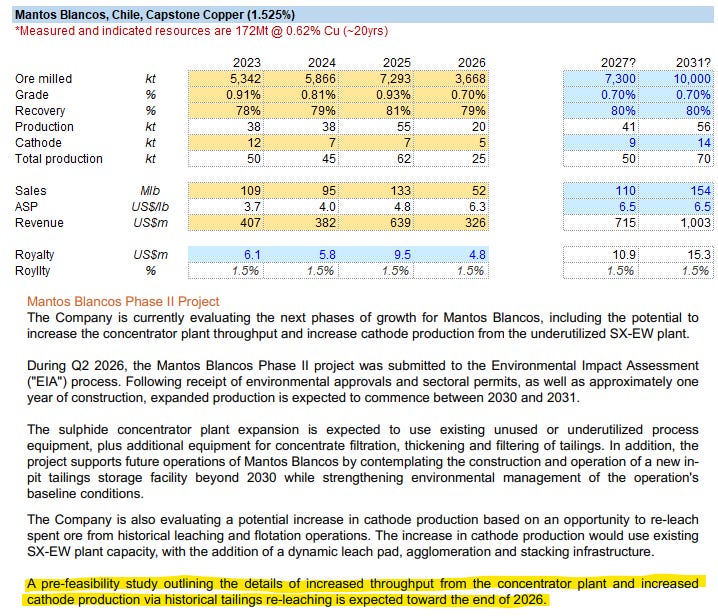
Ecora acquired a 1.525% royalty on Capstone Copper’s Mantos Blancos mine in Chile in 2019 for US$50m. Last year it generated royalty revenue of US$9.5m. It is currently progressing a study to look at expanding both the sulphide concentrator (to 10mtpa) and the cathode production which is expected out by the end of 2026.
Voisey’s Bay
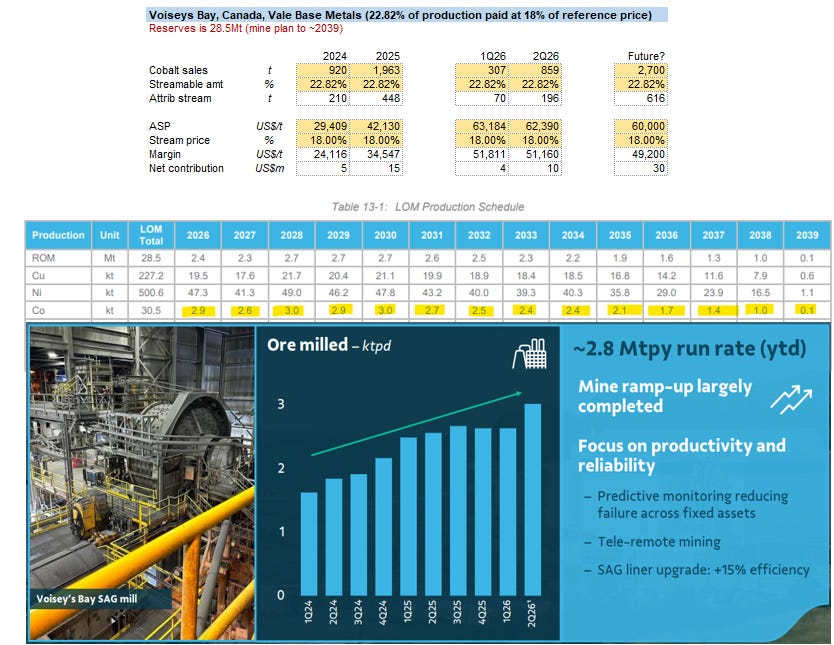
Ecora acquired a stream on effectively 22.82% of cobalt production coming out of Vale’s Voisey’s Bay mine in Canada. Ecora pays Vale 18% of the cobalt reference price (CRP), effectively making the 82% of the CRP as its margin. Voisey’s bay has recently completed an underground mine expansion and is targeting around ~2,600tpa of cobalt production over its life of mine (currently defined out to 2039).
The DRC produce around 75% of the world’s cobalt - 230ktpa out of a 300ktpa market. In response to a collapse in the cobalt price to ~US$21,000/t in February 2025 the DRC imposed an export ban on Cobalt. Subsequently the government has lifted the ban but has imposed a quota of 96,600t for 2026 and 2027. Cobalt prices today are around US$60,000/t but if the DRC were to hold this much product back then perhaps it has far higher to go.
Santo Domingo
The Santo Domingo royalty was a part of the US$185m acquisition of a group royalties acquired from South32 in 2022. This project is owned by Capstone copper and sits just 35km from Capstone’s operating Mantoverde mine in the Atacama region of Chile.
The project is fully permitted, has completed a DFS and is targeting FID by the end of 2026. The project is expected to cost US$2.3bn over a couple of years (it does have infrastructure synergies with Mantoverde) and produce ~100ktpa of copper plus some gold and iron ore.
In October 2025 Capstone sold down 25% of the project to Orion for up to US$360m ($225m on FID, $75m matching within 6 months of FID and $60m contingent on project outcomes). In addition Wheaton purchased a $290m stream on the gold production which they have advanced $30m to date. With copper prices now at all time highs the debt on Capstones balance sheet looks contained to a point they can now FID this.
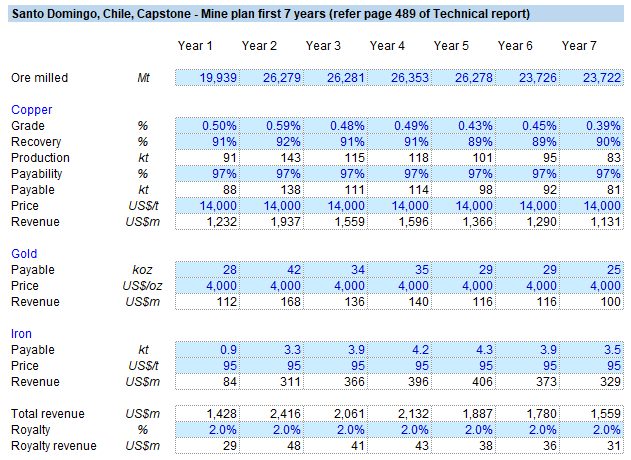
The royalty Ecora holds on the property is a 2% NSR… but note that whilst Ecora is entitled to the royalty over the vast majority of the property - for a portion the royalty is held by another group (Enami). You can see the map on pages 58 & 59 of the technical report in addition to the mine plan. Ecora has guided to being entitled to the first 7 years of production being the higher grade components which checks out to me and they look like they will also be entitled to the northern section of the Iris Norte pit later in the mine life.
The below captures the mine plan for years 1-7 (refer to page 489 of the technical report)
West Musgrave
Along with Santo Domingo West Musgrave was the cornerstone royalty of the package of royalties Ecora purchased from South32 in 2022.
West Musgrave is a copper & nickel project in remote Western Australia. It is now owned by BHP after they acquired Oz Minerals in 2023. The project is fully permitted and on my math has had something close to A$1bn of capital spent developing it before BHP temporarily suspended its nickel operations in mid 2024.
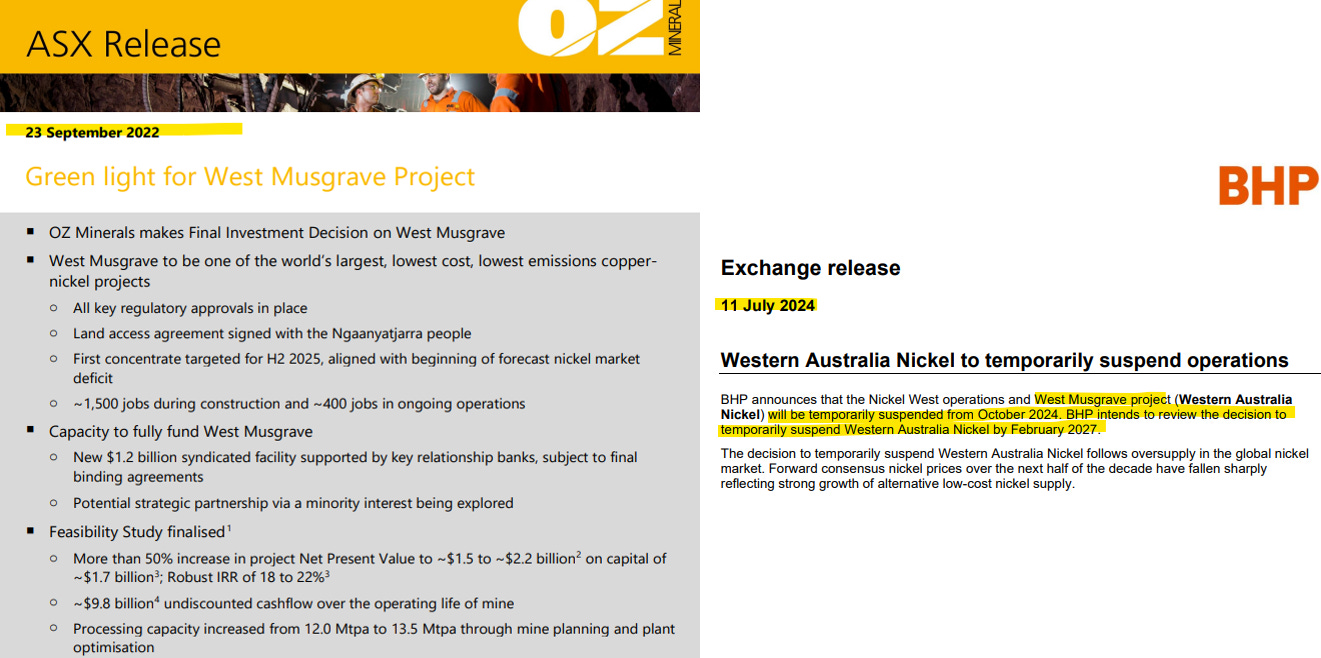
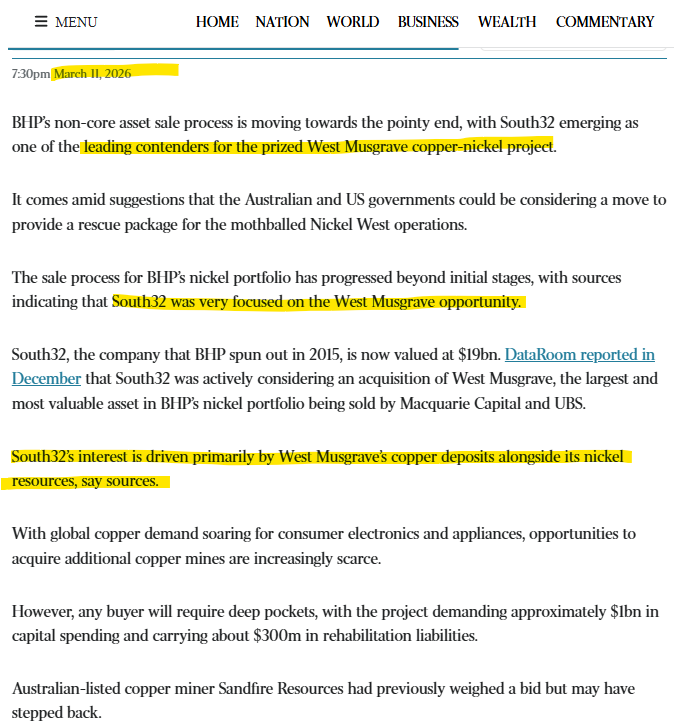
There has been speculation as to what will become of West Musgrave and BHP’s wider Nickel West business. BHP has said there will be a stategic review of nickel business and outcomes to be shared by February 2027 - options could include a sale to a third party, a restart potentially with both US and Australian government funding, or possibly a permanent closure. As the below from The Australian newspaper shows BHP has run a sales process and South32 were rumoured a leading contender as of a few months ago (note that BHP announce annual results next Tuesday 18th August and often use this opportunity to update on any M&A transactions).
The financial metrics of West Musgrave are reasonably attractive, even with nickel prices being somewhat subdued. Revenue is split around 50/50 copper/nickel. The study details are below.. and whilst I don’t believe costs today will be the A$34/t outlined in the 2022 study there is big enough margin for this to move up to as much as A$50-A$60/t and still be very profitable.
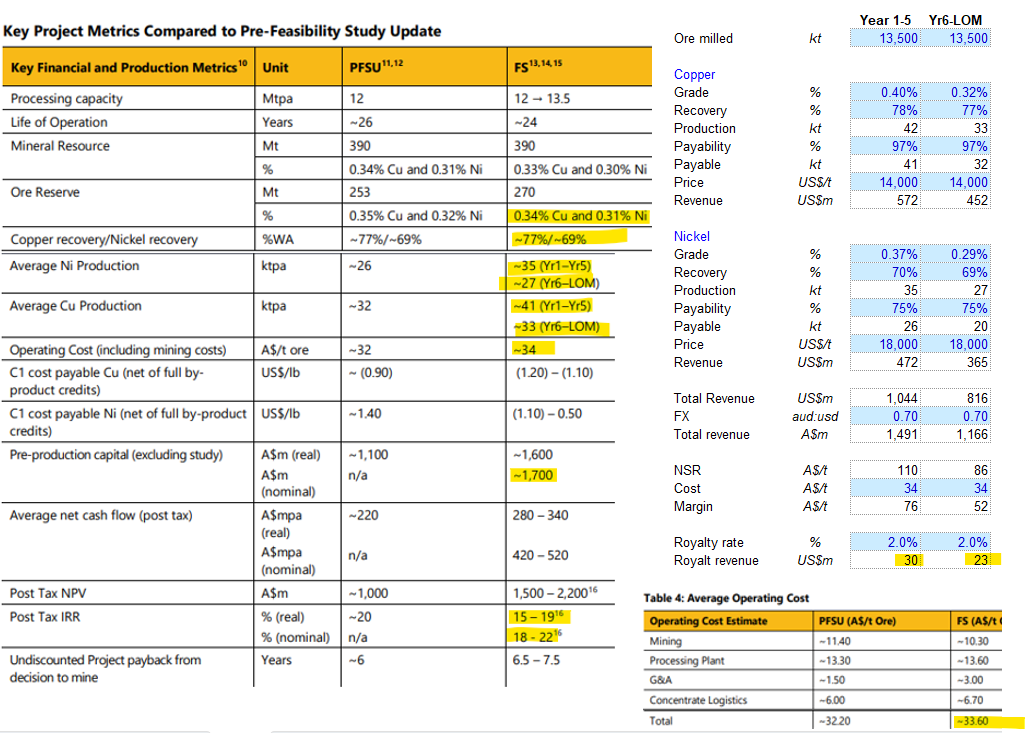
The last thing to note regarding West Musgrave is there is an additional A$10m to be received upon commercial production (separate to the royalty)

Nifty
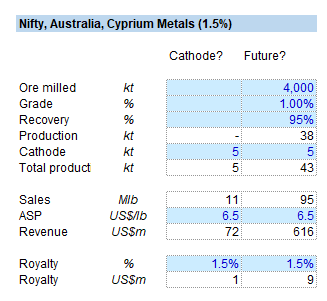
The Nifty royalty also came in the South32 portfolio. It is a 1.5% royalty on the Nifty copper mine in Western Australia operated by Cyprium Metals. Nifty is a past producing mine that encountered some difficulties with its underground operations and closed back in 2019. Cyprium are looking to leach some stockpiles into cathode at a rate of ~5ktpa with first production due in the coming months… and they have plans to restart to larger sulphide resource as an open pit. Given this is a brownfield restart the capital shouldn’t be too onerous.
Mimbula
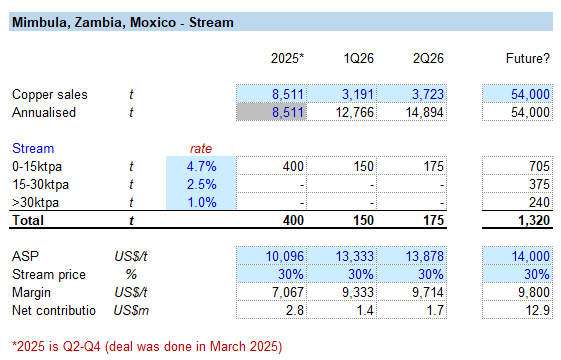
The Mimbula stream is the newest addition to the Ecora portfolio with Ecora giving owner Moxico US$50m last year as part of a funding package to expand production. Mimbula began production in 2022 at ~15ktpa of copper and the expansion is set to take it to ~56ktpa. Commissioning of the expansion began in June.
Ecora is entitled to a stream on 4.7% of production up to 15ktpa, 2.5% of production from 15ktpa to 30ktpa and 1.0% above 30ktpa. Ecora pays 30% of the LME price for the copper and effectively makes the remaining 70% as margin. The mine has defined resources for production out until 2035 with extension potential.
Valuation
You have to have a little imagination here… but with:
Santo Domingo looking to FID at end of 2026
West Musgrave to either be sold or restarted by February 2027
DRC controlling the cobalt market
Mantos Blancos releasing a PFS on its expansion by end of 2026
Mimbula commissioning its expansion as I write; and
Nifty restarting imminently…
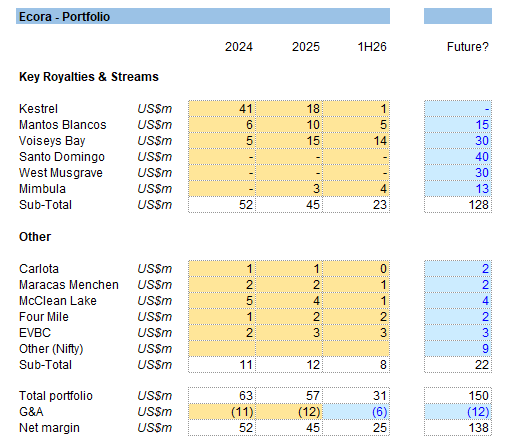
….there is a scenario where I think the Ecora portfolio can print ~US$150m pa in the near future (the company even suggest as much in their latest presentation). Even without copper prices moving one would expect this could be worth something close to US$1.5bn. Today you can buy the company for US$550m MCAP .. and if you factor in Kestrel and some of the other royalties such as Patterson Corridor East.. you may actually be paying closer to US$500m.
Future Upside
Ecora has little competition in the base metals royalty and streaming space (for now) - less competition = more capacity to do accretive deals.
The company took on some decent debt to do the South32 and Mimbula deals but with the portfolio generating good cash flows I think net debt should have been around US$60m at 30 June when the company reports in the coming weeks. In addition - with all of the above mentioned catalysts, the copper price at all time highs and Kestrel mining through Ecora’s royalty ground in 2H26 - I think there is a good chance Ecora ends the calendar year in a net cash position.. or somewhere close to.
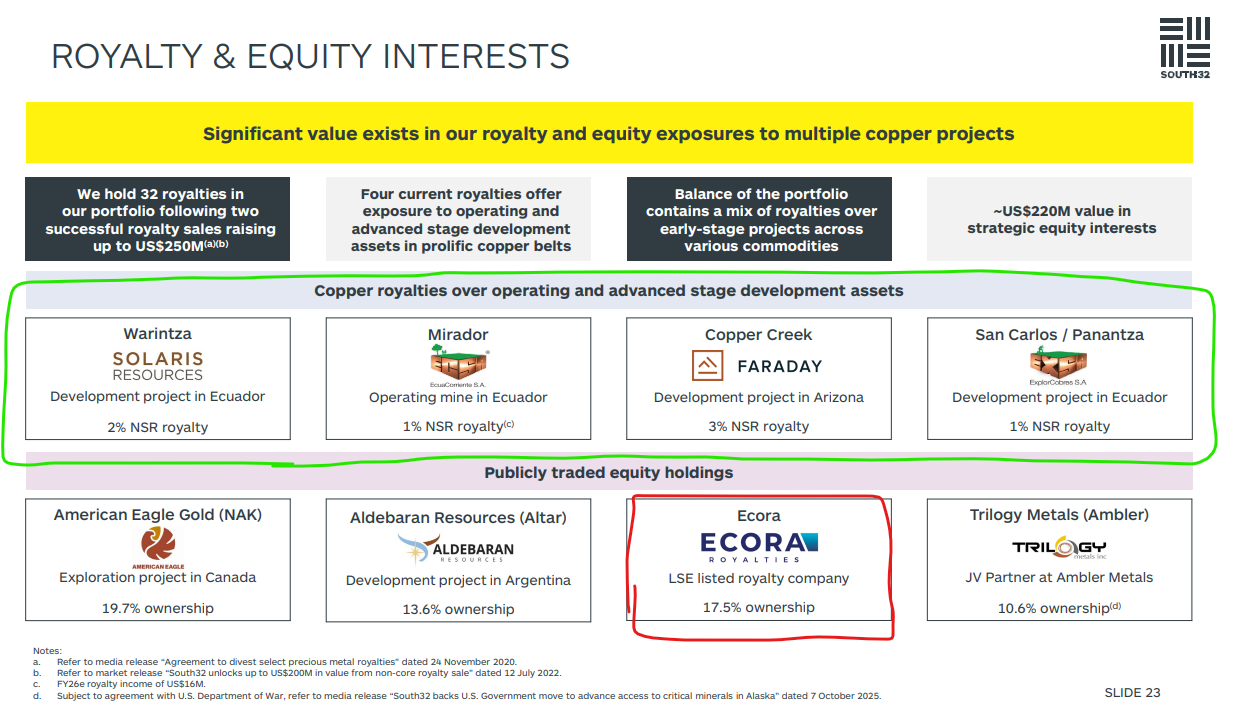
This opens the door to further deals… and I wouldn’t mind having a guess that Ecora’s 17.5% shareholder South32 (who took scrip as well as cash when doing the 2022 transaction) may look to do a further deal with Ecora involving the below portfolio of highly attractive copper royalties..
Risks & Concerns
I’ve always thought of the royalty business as a fairly simple one… you need some technical consultants to look through geology and key engineering challenges on the mines you are looking to finance, you need someone to count the royalty cheques and you may need some bankers and legal advice when transacting. Why a company like this has 8 board members and US$12m in annual SG&A is beyond me and it really emphasises the need for these royalty companies to have scale (which Ecora now has).. otherwise if you have just a few royalties it gets eaten up by G&A. So - the egregious corporate costs are a concern of mine (decent synergies if you fold the royalties into another vehicle and get rid of this).
My concern with management historically is they had little skin in the game with regard to ownership in the company and were looking to do deals without an owners mindset (profitability was sometimes a secondary thought). But I am less concerned with this as time goes by with the new CEO given the track record and given they have even ate their own cooking with regards to buying shares on market.
The other key risks & concerns are around those two key development projects (Santo Domingo & West Musgrave)… if for whatever reason they cannot get built in the next few years the valuation looks far less attractive, though I would argue that you could get away with just one proceeding for the company to be of decent value.
Summary
If you believe, like me, that government will continue to do stupid things like print money, chase unrealistic dreams like net zero and continue to disturb market price signals by doing things like imposing additional government “windfall” taxes - then royalties are a good way to protect you from this stupidity.
Other than welfare governments are spending much of this money on military applications and encouraging investment into reshoring manufacturing, electrification and other key productivity enablers such as data centres - these are all extremely capital intensive and commodity intensive endeavours. Royalties on base metals are a great way to give you exposure to these areas.
Ecora offers exposure to industrial metals such as copper without exposure to the cost, depreciation or taxation lines on a miners P&L. And it does so today at a price that is below the cost of what they incurred to acquire those royalties some time ago in a different commodity price regime.
Other than Ecora’s coal royalty soon depleting and the company becoming a 100% critical minerals royalty play.. it has a number of added catalysts that I believe play out over the next 6 months including: FID on Santo Domingo, a sale or restart of West Musgrave, the commissioning of projects at Mimbula and Nifty and key studies to expand production at other mines. It also now has a clean balance sheet that could afford it the opportunity to do some accretive deals.. perhaps with parties they have dealt with before.
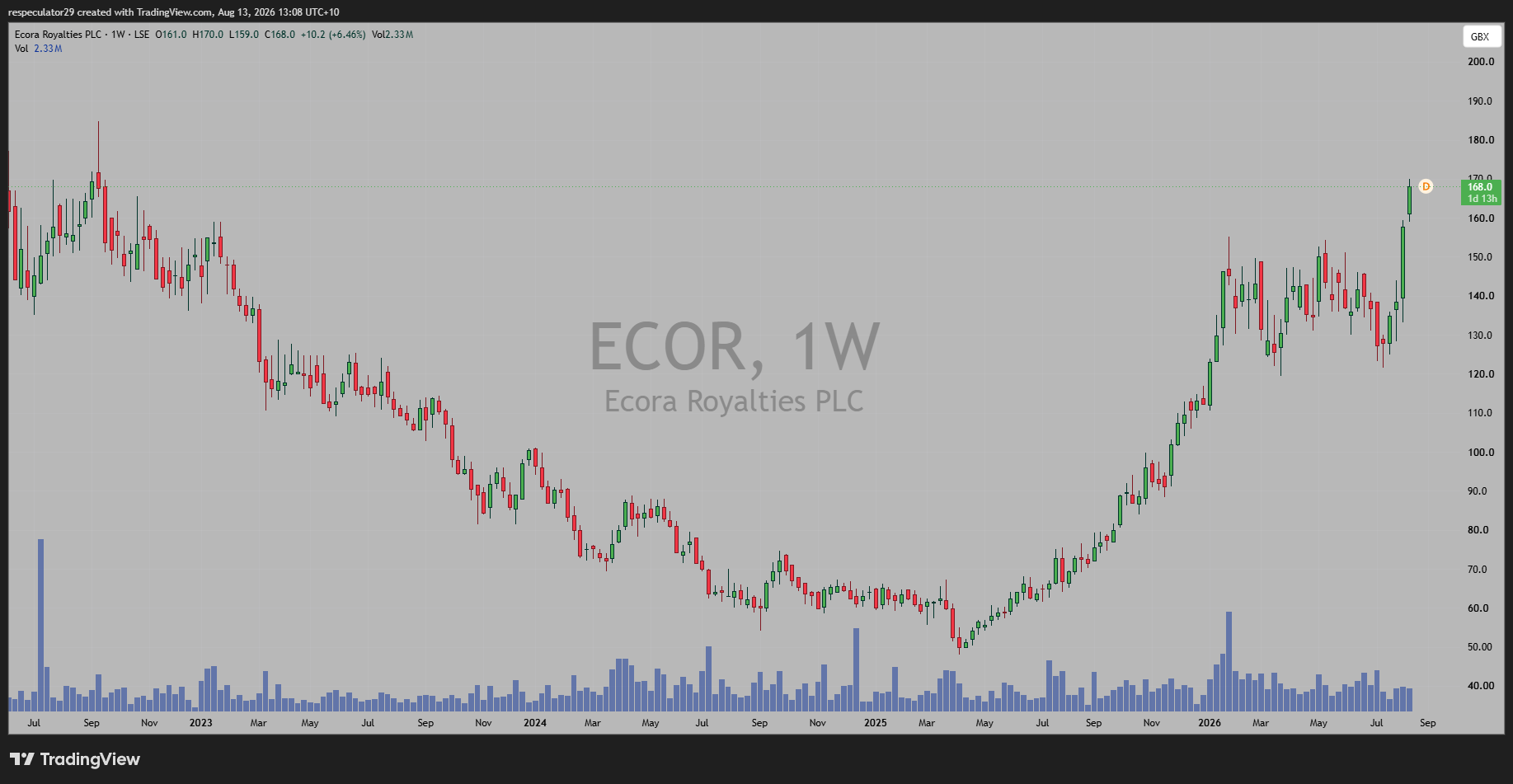
And for the chartists out there…. this doesn’t look too bad either
Let me know your thoughts
Respeculator
**Disclaimer - this is NOT intended as financial advice - before acting on any information, you should consider the appropriateness of the information provided to your financial situation and seek advice. Whilst every effort is made to ensure the accuracy of data provided there’s a good chance inaccuracies exist. This is opinion only.**
Another convert. My work is done. Haha jokes - great piece mate
Good read. The vanadium royalty is interesting.