
Capturing the Arb
Taking advantage of a cost of capital delta

There’s a lot of quirks in how mining and mining related companies get priced by the market. Investors ascribe premiums or discounts to companies based on a number of factors/preferences including the commodity they mine, the exposure they provide to that commodity (ie if they get exposure to purely the revenue line like a royalty or streamer or want added torque via exposure to the cost line and/or exploration), the jurisdiction they are located in, the Asset quality… etc etc. Some of these make a lot of sense, some less so.
I made the observation when I kicked this blog back off a couple of weeks ago in the note “We’re back (for now)” that the premium that used to be given to miners for diversification of earnings (ie across commodities, geographies etc) was dead. And investors were paying larger and larger premiums for clean exposure to “future facing commodities”.
How the multi billion dollar diversified majors have responded to this change in investor appetite has been quite interesting. Many have shed their exposure to commodities on the nose such as coal via spin outs or Asset sales. Some like Rio Tinto have recycled the proceeds from businesses like iron ore into markets like lithium. Some like Anglo have completely gutted their portfolio and combined with Teck (who did the same) to focus on the what investors are paying a premium for - copper in the America’s. Vale even created a base metals division and sold down a 10% stake in this entity to the Saudi’s for US$2.5bn - quite the sum for something that was getting ascribed little to no value for.
There have been some even more creative moves of late to capture the change in investor preference and ultimately a cost of capital arbitrage…
BHP sold a stream on the silver produced from its share of the Antamina mine to Wheaton earlier this year. This transacted at US$4.3bn which is a value higher than analysts were giving BHP for their entire 33.75% stake in Antamina and yet silver sales represented just ~8% of revenues and ~12% of EBITDA of the mine.
At the end of last year BHP sold 49% in some power infrastructure assets used by its Pilbara operations for US$2bn and is in talks to sell some transmission lines used by its Chilean copper mines for US$1.5bn.
Minority stakes in copper projects Winu (Rio Tinto), Copper World (Hudbay) and Santo Domingo (Capstone) were sold down to the likes of large Japanese industrials /trading houses - Sumitomo and Mitsubishi at arguably significant premiums to what the market was valuing these projects inside the miner.
All of these transactions have captured a cost of capital difference/arbitrage between miners, royalty and streamers, infrastructure funds and Japanese trading houses. These deals are accretive to both sets of shareholders and allow miners with a higher cost of capital to take cheaper capital and deploy it into the higher risk / higher returning components in their portfolios… that of which investors are seeking exposure to.
Today I’m exploring a potentially longer dated play in a company that’s reshaped its portfolio over the last few years into some of the types of Assets investors are now paying a premium for… but arguably this premium is yet to flow through to its stock price. I look at potential ways the company could capture the cost of capital arbitrage if investors aren’t going to reprice it.
Background - South32
At the start of the month - on July 1st - South32 entered into a transaction with Alcoa to sell its Aluminium Assets for ~US$5bn… US$3.1bn cash, US$1.0bn stock (to be distributed out), US$0.75bn price contingent and US$0.75bn from the removal of lease liabilities. This transaction is likely the final or penultimate (depending what they do with the remaining manganese Assets) deal of a complete portfolio transformation that’s occurred over many years.
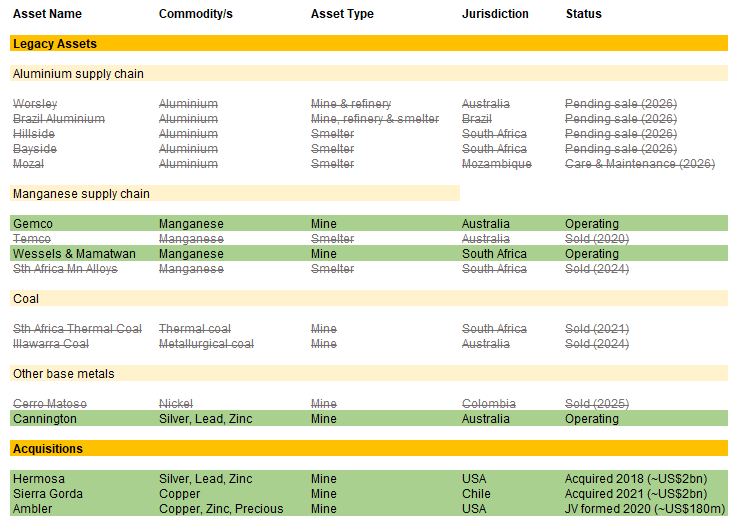
South32 started out in 2015 after being spun out by BHP. It was made up of BHP’s unwanted Assets in Aluminium, Manganese, Nickel and Coal (plus Cannington). According to the company they started out with 16 Assets (mostly ex Billiton) - a mix of mines and downstream refineries/smelters in numerous geographies.. predominantly South Africa and Australia. South32 was a name chosen as both Perth and Johannesburg lie 32 degrees south of the equator (that name might need changing soon!).
Today, assuming the transaction with Alcoa closes, South32 will have just 3 Assets remaining of the 16 it started with. In addition to these they’ve acquired 3 Assets since listing. Take a look at the changes below - you can see a deliberate move by the company to focus on upstream assets (mines), on certain jurisdictions (namely the Americas and Australia), and on certain commodities (copper and other base metals).
These slides paint the picture going forward….
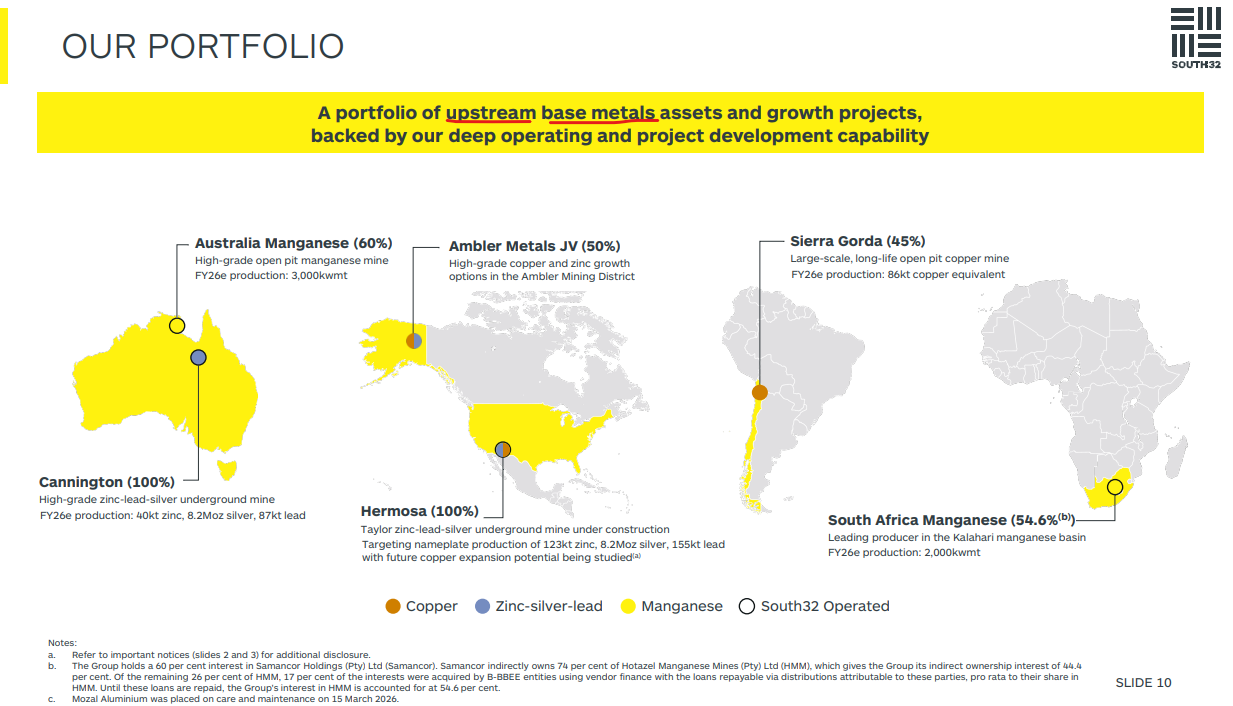
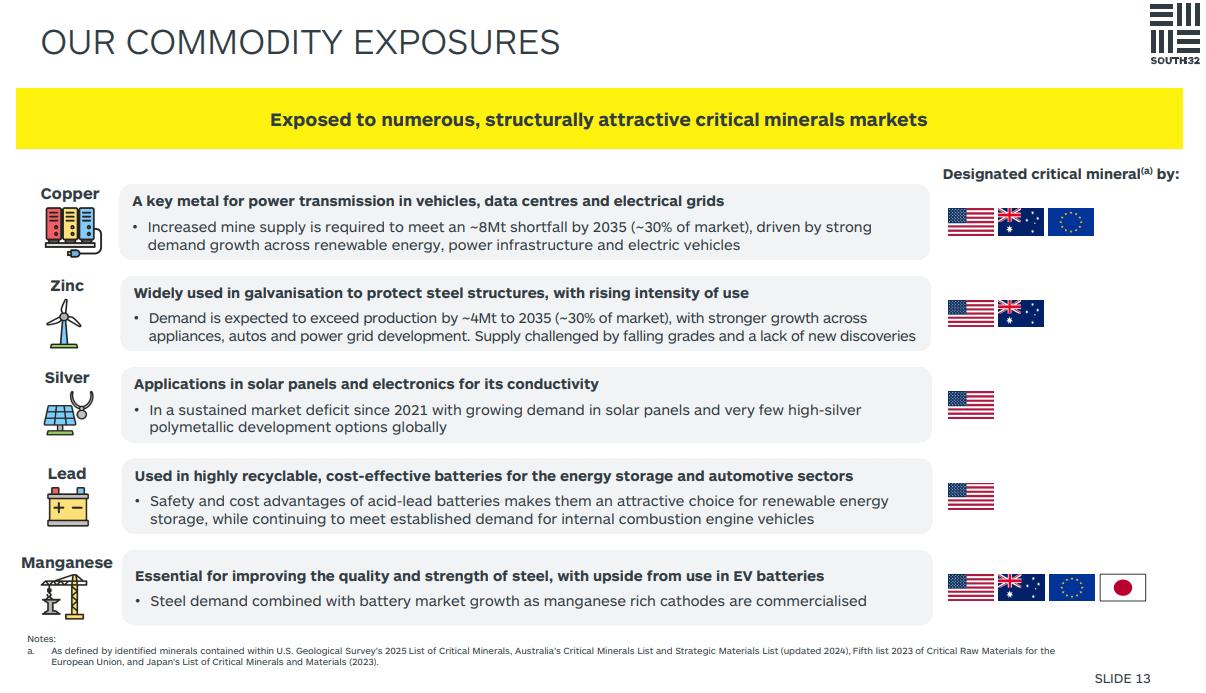
The reasoning for the complete portfolio transformation is somewhat obvious.. management had a view of the world and what they/investors wanted and went after it. Whether it was wise to use the vehicle they inherited is another matter - but I’m sure bankers aren’t upset with them for doing all these transactions. I should also note management were incentivised to go after it given bonuses were tied to reducing carbon emissions (what better way then handing high emitting assets to others!) and to “portfolio management”.
Valuation
We need to remove all the noise of the Alcoa transaction and other legacy transactions S32 is yet to complete in order to establish a baseline valuation for the new post transaction entity (“CleanCo”). My math is below, note that I am assuming S32 look to sell their Manganese business where the JV partner (Anglo) also has a for sale sign out.
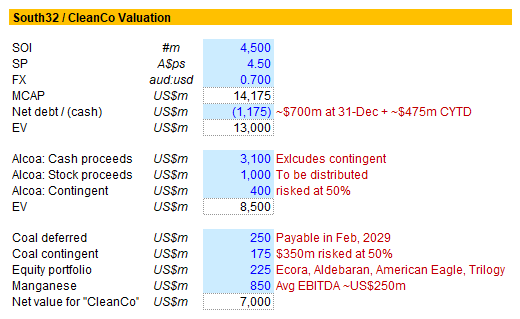
On my math the market is attributing a value of circa US$7bn for the portfolio of Assets which offer clean exposure to “critical minerals” in the Americas (plus Australia). Lets have a very brief look at the Assets in this portfolio - but first a quick look at a company that embarked on a very similar journey only a two years ago.. Teck Resources.
Teck parallels
Back in 2024 Teck Resources sold its coal Assets to Glencore in order to unlock capital and focus on its copper and base metal Assets in the Americas.. much like what S32 is embarking on. At the time in the prior version of this blog I hypothesised whether Teck may get an “ESG rerate” and trade at a multiple closer to pureplay peers like Antofagasta (read: Teck Coal Assets Sold, Time For An Esg Rerate).
Well history now says they didn’t. But many will argue Teck’s underperformance was more a result of poor execution, particularly at its key growth project QB2. This is something to be aware of as South32 also has a key growth project at Hermosa which I’ll touch on later (and it has already had multiple capex revisions).
But execution aside Teck didn’t last long as a standalone entity with Anglo lobbing a bid just a year after the coal assets were dispatched (albeit a nil premium merger).
Asset Overviews
A really brief Asset description as follows:
Cannington (100%)
Started production ~30yrs ago. Is currently a smallish scale (~2mtpa) high grade underground mine up in the Mt Isa district of Australia.. producing silver, lead and zinc. Has 10mt UG reserve (~5yrs), 50mt UG resource (~25yrs) and has the option of an open pit (~25mt resource) which is currently being studied with a decision in the next ~12mths.
Sierra Gorda (45%)
Started production in 2014. Is a large copper porphyry system in Chile producing ~200ktpa CuEq (~90ktpa S32 share) by processing ~48mtpa at ~0.55% CuEq. ~700mt reserve (~17yrs), 1.7bt resource (~40yrs). Has just hit FID on a project to expand processing capacity from 48mtpa to 60mtpa.
Hermosa (100%)
Development project acquired for ~US$2bn in 2018. Around a further ~US$2bn spend to date on studies and development. Just increased capex budget by from ~US$2.2bn to ~US$3.3bn. I estimate around a further ~US$1.8bn and ~18months until completion. Hermosa will produce silver, lead and zinc from a large underground mine (4.3mtpa) in Arizona with the potential to add copper and manganese at a later date. 65mt reserve (~15yrs), 153mt resource (35yrs) with strong potential for extension.
Ambler (50%)
Development project/s (Arctic and Bornite) in the Ambler region of Alaska. High grade copper (with zinc, gold and silver). NPV’s in excess of US$2bn. Is in the permitting phase and awaiting construction of a road to connect the region to the rest of Alaska. Long term growth option.
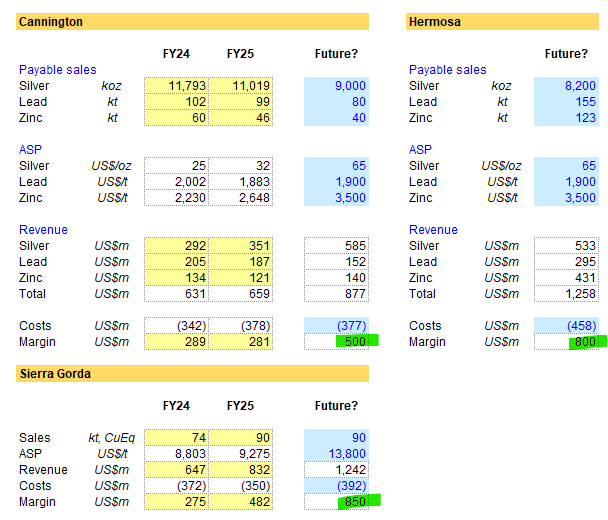
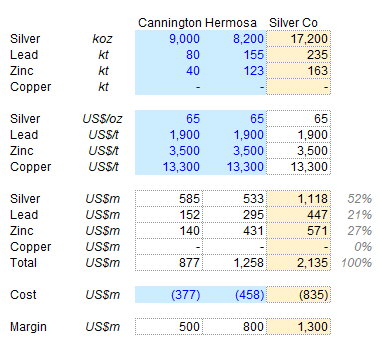
The above shows a rough estimate of earnings at spot commodity prices. It highlights US$2.15bn EBITDA which on the US$7bn implied valuation for “CleanCo” has it trading at ~3x EBITDA. This compares to other CleanCo’s trading at 8-10x. And even if you exclude Hermosa it’s trading at ~5x EBITDA.. which is cheaper than peers and you get Hermosa and Ambler “for free”. So perhaps there is some value to be had and that seems even more evident as we look at other areas of the market which have premium multiples / lower costs of capital.
The Silver Miner Arb
One of the many quirks in mining valuation is investors pay a premium for exposure to pureplay silver miners, especially in North America. I italicise pureplay because there isn’t really such a thing.. they all seem to have some kind of by/co-products be it gold or base metals. Pureplay for these purposes I’ll class as >40% of revenue.
I am yet to really hear a valid reason why pureplay silver miners trade at such a premium but a couple of thoughts:
Supply v Demand. There are few silver companies and many silver bugs.
Paying an option premium for the right tail moon. When in a bull market silver and silver miners historically move the furthest. For such an illiquid market you can get trapped out of this market - especially big pools of capital. So you need to pay a premium for the front row ticket to the moon, and perhaps that’s why silver miners trade like they do.
Anyway - for whatever reason they trade at a premium and some proof below looking at Hecla Mining which is a pureplay silver producer with 3 operations in the US and Canada producing ~15Mozpa. It trades with a market cap near US$10bn and EV near US$9bn with estimated EBITDA of US$900m.. so it trades around ~10x EBITDA.
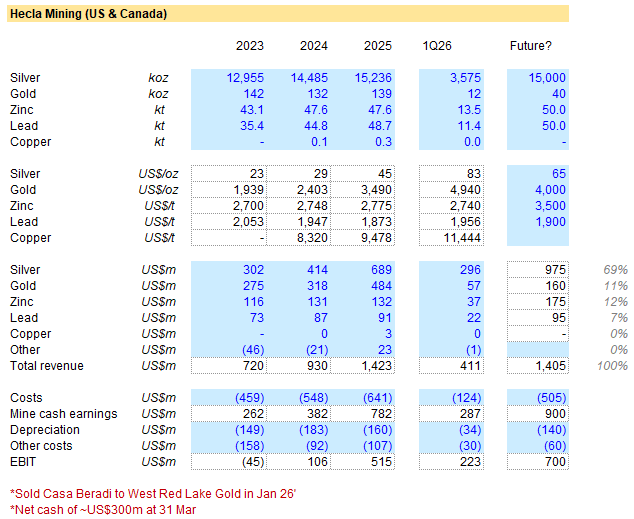
Lets compare this with the S32 “SilverCo” made up of Cannington & Hermosa… where not only does it do more silver production (~17Mozpa vs ~15Mozpa) but SilverCo produces at a negative cost (versus Hecla at positive) and produces EBITDA of ~US$1.3bn (versus ~US$0.9bn). Could this trade at 10x (ie US$13bn) like Hecla? Then add in consideration for Sierra Gorda & Ambler and we are miles above the US$7bn market valuation for CleanCo above?
The Silver Stream Arb
As I said in my last note Sink or Stream streamers have become a key source of cheap capital for the mining sector. And as I mentioned at the top BHP recently took advantage of this cost of capital arbitrage by selling a stream on its interests in the silver production at the Antamina mine. This US$4.3bn stream was for an effective ~4.5Mozpa (80% on ~5.6Mozpa) for the first ~25years.
Given both Hermosa and Cannington produce silver at a “negative cost” (the zinc and lead pay the bills) there’s little reason S32 couldn’t sell a stream of similar size.. particularly at Hermosa who has a much longer defined mine life (akin to Antamina). A similar stream would unlock US$4.3bn of capital out of US$7bn “CleanCo” and probably only reduce EBITDA by ~US$300m pa. Ie CleanCo post stream could be producing something like US$1.8bn EBITDA on a US$2.7bn EV (!!)
Risks to capturing the Arb
I’ve made the case above that post the Alcoa transaction closing, the remaining S32 Assets (“CleanCo”) should trade at a far bigger multiple than is currently being ascribed to the Assets inside South32. But there is a number of risks to getting that premium valuation.
Poor project execution
I mentioned above that what killed the returns for Teck shareholders after it became a “CleanCo” was its execution on its key growth project QB2. This risk applies to S32 with Hermosa. S32 are around half way through the build (18mths and ~US$1.5bn in with 18mths and ~US$1.8bn remaining) so plenty of risk remains. However they did cleanse the market in April on the capex blowouts (pointing to increased material costs due to US tariffs and a change of scope) and should now have a solid understanding of the task at hand so further material blowouts seem less likely.
Inability to reach the markets that would ascribe a premium to these Assets
There’s a saying “go where you’re valued, not where you’re merely accepted”… and that applies here. If the company stays based in Australia, listed on the ASX with a name like South32 despite having this portfolio of “critical minerals” Assets in the Americas… then I feel they will not capture the premiums being offered by certain groups of investors. Just look at EQR resources versus Almonty in the Tungsten space if you want to see the premiums paid by US investors looking for critical minerals exposure (EQR just announced their intention to list in the US today and is up 16% currently on this news). But one needs to question why they crafted the portfolio of projects in the Americas if they weren’t trying to target investors in this market.
Poor use of capital
In addition to inheriting BHP’s unwanted Assets, one could argue South32 inherited BHP’s corporate culture (some may say this is also unwanted but I won’t 😉). So the risk is the Alcoa proceeds are ploughed into poor returning investments or consumed via unnecessary corporate overhead or blown out capital projects (Hermosa has gone from ~US$2bn to ~US$3.3bn after all). My pushback here is a new CEO started on the same date as the Alcoa transaction (1 July) and I struggle to see this person put their reputation at risk so early on by ploughing material amounts of the proceeds into an acquisition.
Trade Set Up
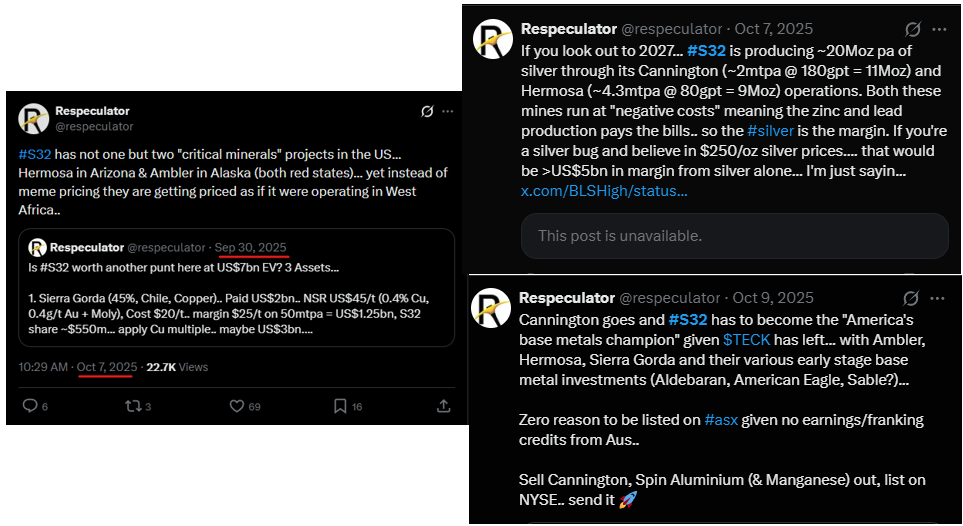
This is not a new idea of mine. I rode S32 from late September last year <$3/sh up until a few months back at ~$4.50/sh and retain a small holding. I was buying then purely given how cheap it was and reduced not necessarily because it was expensive but to lock in profits given the big rerate and given the market had became a lot more uncertain post the events of February 28th. What has changed today and why I wanted to revisit this as an investment idea is the Alcoa deal.
While I see deep value and various ways the company can look to exploit the value arbitrage I’m hesitant to buy any material amount of stock here. This is more based on current market conditions in addition to the fact a new CEO just come on board - so I see very little chance anything gets acted on with regards to capturing value arbitrages any time soon, especially whilst the Alcoa deal is yet to close.
And with a volatile market and execution risk on Hermosa remaining I’m more inclined to step aside here and watch. It will be fascinating to see what the company announces with regards to capital management at their full year results in August. They have reduced their share count from ~5.3bn SOI to ~4.5bn SOI over the years via buybacks… and I wouldn’t mind guessing they execute another good sized buyback given the share price and their cash balance.
I’ll probably look to revisit this closer to full year results in late August; early next year when the closure of the Alcoa deal and completion of Hermosa is in sight or; when the stock falls <$4/sh as it was only a week or two ago.
Summary
Investor preferences are a key determinant on the cost of capital of and the multiples attributed to publicly listed companies. Today there is incredibly strong investor demand for companies operating and developing critical minerals projects in good jurisdictions, especially from North American based investors.
South32 post the completion of the recently announced transaction with Alcoa has crafted a portfolio of Assets that now fits this category and could potentially warrant a far greater premium than is currently ascribed to the Assets in the South32 stock today. But to receive that premium I believe the company has to at the very least execute on its key growth project along with seeking a name change and a North American listing.
Given the cash pile South32 sits on and the major catalysts over the next 18mths (including closing the deal with Alcoa, commissioning the Hermosa project and progressing the Ambler mining project) I don’t mind it as a decent risk/reward and will have it high up my watchlist to add either when it gets cheaper or I can see material progress toward unlocking the premium multiple.
Are there any other CleanCo’s trading without a DirtyCo multiple?
Respeculator
The pureplay trade is an interesting one. That’s why I am invested in Santacruz, they are about 60% Silver now and have crashed with the price. But that will increase to about 80% soon and the thesis(partly) is that the valuation gap will close.
Great piece, thanks for sharing your thoughts!