
Sink or Stream
Which way for this copper sh!tshow?

After reading the note I released a few days ago on Aurelia Metals and what I’m about to write - you’d be forgiven for thinking I’ve got some kind of fetish for small scale, underground, polymetallic orebodies with a bunch of warts. Maybe there’s an element of truth to that - but I think it’s more part and parcel of being focused on the Aussie resource market where the geology means you see more than your average share of these types of opportunities… and I’m like a moth to a flame when it comes to a beaten down stock no one wants to touch.
In this post I wanted to bring together and recap in a longer form piece some thoughts I have been sharing for the past year on an asx copper sh!tshow.
29 Metals (29M.AX) started out 5 years ago when it IPO’d on the ASX on July 2, 2021. The IPO saw 55% of the company effectively sold down/floated by private equity firm EMR capital with EMR retaining the remaining 45%. The entity listed with ~500 million shares out, priced at ~A$2/share (for ~A$1bn MCAP) and had 100% ownership in two operating copper mines - Golden Grove in Western Australia and Capricorn (aka Gunpowder) in Queensland.
Fast forward to today and 29M has 1.75 billion (!) shares on issue, trades at 23 cents per share (for ~A$400m MCAP) with the same existing Assets. So what happened? And why should you now be interested in a company that has destroyed ~90% of IPO holders equity and cut the market cap by 60% despite a raging metals bull market?
What happened?
It takes either a lot of bad luck or stupidity (aka bad management) to lose ~90% off your share price when the underlying commodities you mine is up by over ~70%. Just have a look at the below… (!)
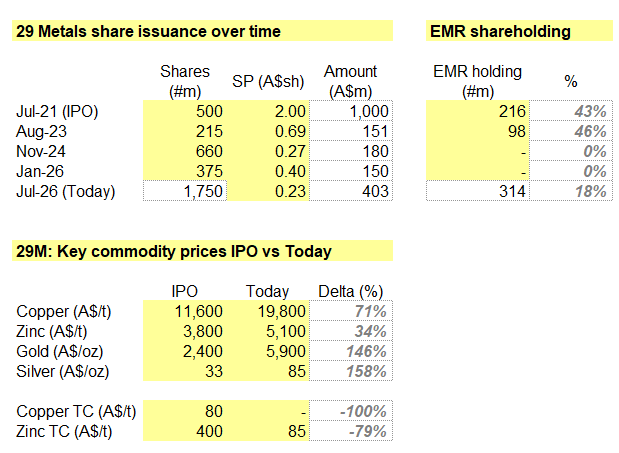
My take - which is probably not the consensus take - is that a lot of what has caused the big disconnect between underlying metals prices and the price of 29M stock has been more misfortune than mismanagement… but there are certainly elements of both. More specifically I attribute todays dismal share price to the following:
A flooding event at the Capricorn Copper mine;
Sub-optimal operating conditions at Golden Grove primarily the result of continued seismic events;
Onerous contracts;
An undercapitalized balance sheet.
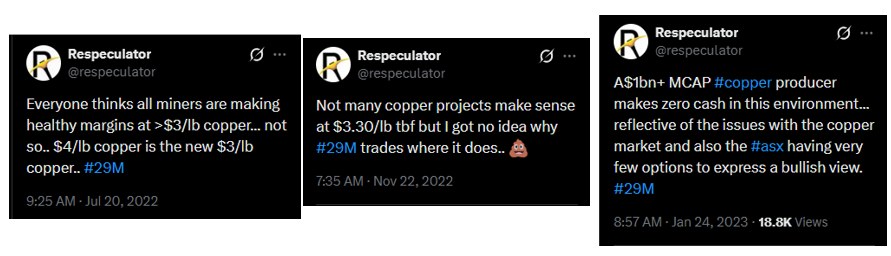
Before we delve into each of these - I do want to point out that once upon a time I thought this company was materially over valued.
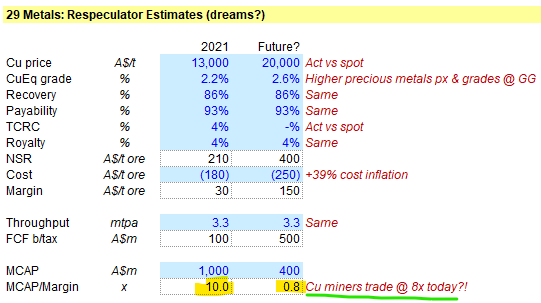
When 29 Metals IPO’d in 2021 it was mining copper from two small scale (<2mtpa), underground, remote mines. Because of this costs were quite high and even though they were mining decent grading orebodies (>2% CuEq) they struggled to make any money at the prevailing metals prices. Whats changed? Not the cost base - if anything costs have grown at a rate well in excess of inflation (welcome to Australian mining). Whats changed has been the metals markets which have been flying (welcome to capital cycles!)…. and also the price of the company (down 60%).
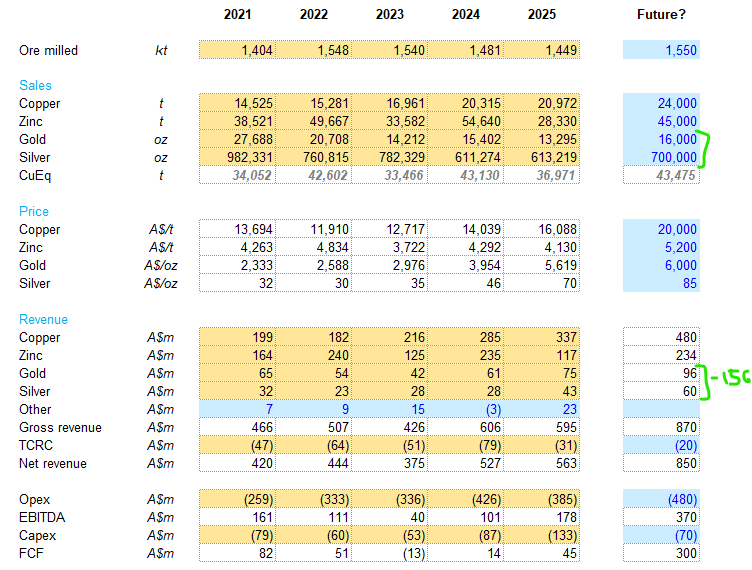
The below shows what I saw in 2021 and what I see in the medium term if things go to plan. Okay there’s a lot to do to achieve the below but really if you compare columns all I'm saying is IF (big if) 29M restore their operations back to where they were operating in 2021 and capture the current metals prices there is massive upside to the share price. And as I’ll show later on - both mines had been consistent performers over a long period of time… just not recently.
1. Capricorn
The flooding:
The Capricorn Copper mine sits in the Mt Isa region of North Queensland, Australia. Mt Isa’s climate is characterised by extremely hot and wet summers (November through March) and dry mild winters (May through September).
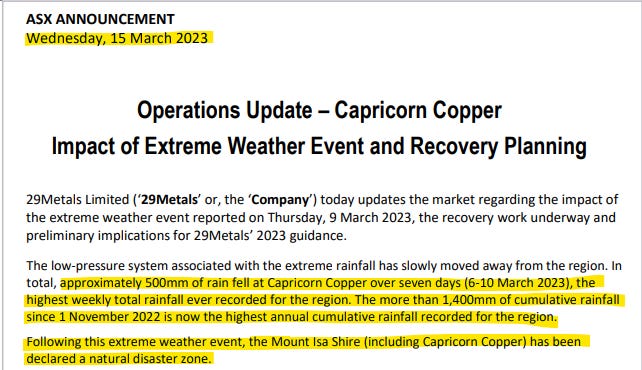
It’s not rare to have heavy summer rains in Mt Isa… but over a three day period in March 2023 the region received a whopping 431mm of rain which is the highest 3-day total in all 133 years of records. The area was declared a natural disaster zone and the event described as a 1-in-200 year occurrence.
Whilst there are many mines in the Mt Isa region - none were hit quite as bad as Capricorn Copper where already elevated surface water levels from an above average wet season meant the rapid downpour resulted in flash flooding cutting off site access and causing material water egress into the Esperanza South sub-level cave.
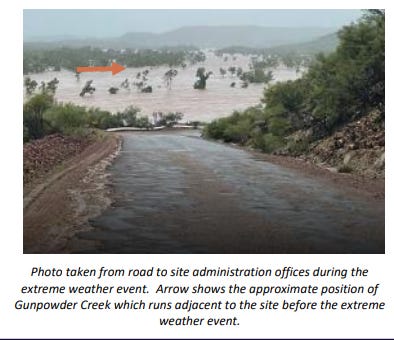
Post the event 29 Metals issued a plan to the market in May 2023 which targeted a restart of mining in September that year… and the company spent tens of millions of dollars on water management infrastructure such as pumps, water diversions, evaporation guns and converting the concentrator into a water treatment plant. But time and permit restrictions on site water releases were not on Capricorns side… and the 2024’ wet season soon came around and with it three consecutive cyclones which buried any chance of a restart. So the company suspended operations, placing the mine into care and maintenance in March 2024.
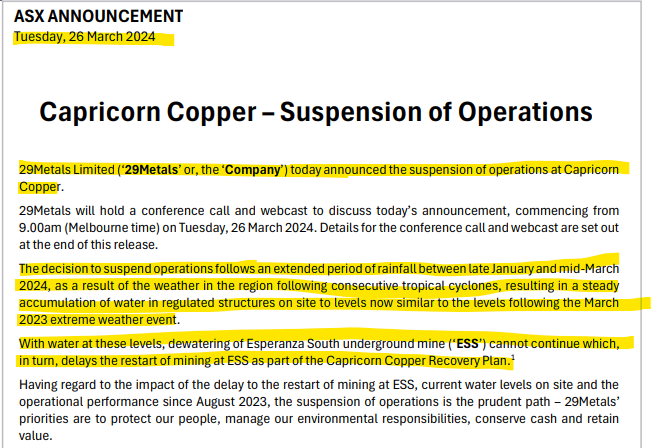
There’s a couple of takes on why Capricorn was the worst hit mine in the region and the only mine to close for an extended period. The compassionate take might be that the mine sits in a water catchment area adjacent to the Gunpowder creek and so is far more prone to flooding… but the cynical take is that the site had very poor water management infrastructure and practices - so much so the site (which was owned and operated by a different group at the time) were repeatedly warned and even issued Environmental Protection Orders to reduce the volume of water stored on site. The below is taken from the IPO document (published June 2021) - take a read.
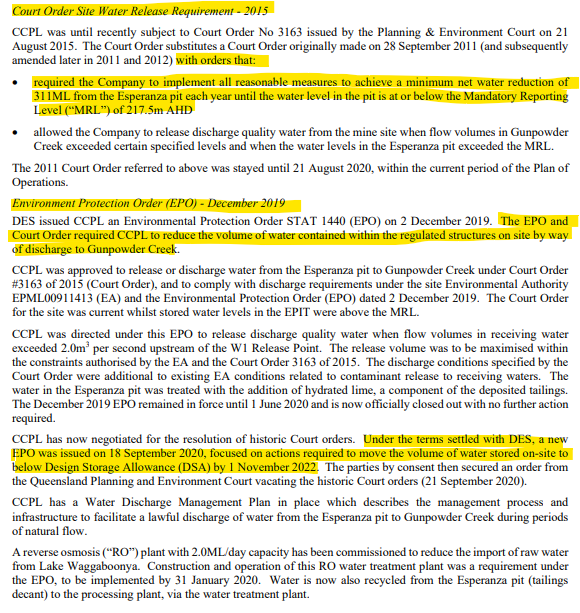
Whether the result of failed management practices or solely the result of a 1 in 200 year event we’ll never really know.. My take is capital was scarce for these projects 10 years ago at a $3/lb copper price and so perhaps the water management infrastructure and processes weren’t as good as they could have been if capital was more freely available.
The recovery:
What has happened in more recent times since the closure in early 2024 is the operation has been through a further 2 wet seasons, reduced water levels by 2 gigalitres, invested in water management infrastructure and kept operations at a point where they can turn on without too much time and capital. They have progressed with government a plan for a longer term tailings storage facility (TSF3) - and it is now the approval of this plan that is the final step before FID and restart.
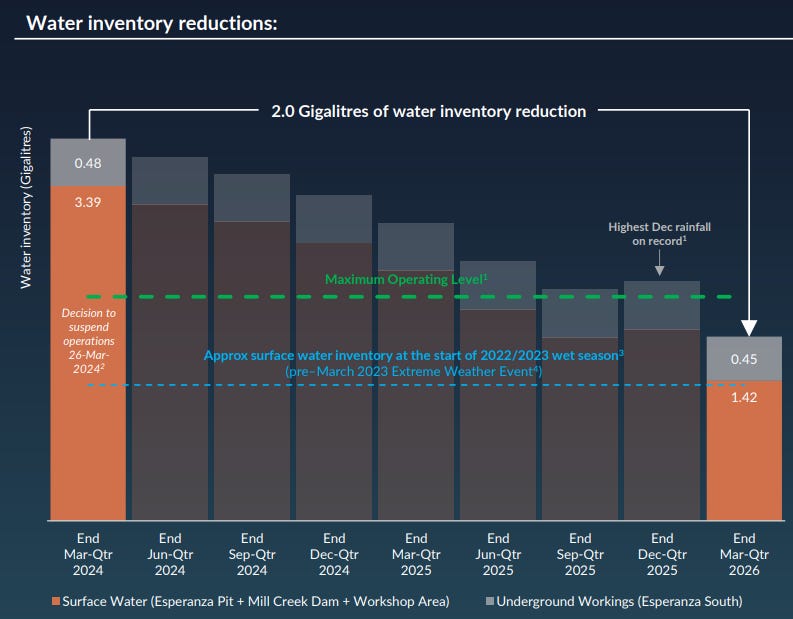
The quarterly released last week suggests they expect to hear back on an RFI submission to government this quarter (3Q26) regarding TSF3, after which (should it be successful) there will be a public notification period and final assessment. So in my mind we may have approvals in place to be re-establishing operations after the completion of the upcoming wet season… around April 2027.
The company is working on a restart feasibility study in the interim where among other things I think they will be looking at what further investment is required for water management and whether they run the same sized operation as before or look to do something bigger given the resource base. The operation is a 64mt resource, 19mt reserve.. and was operating at ~1.7mtpa (so 38 year resource life, 11yr reserve life).
The cost and the prize:
Capricorn has cost 29M circa A$150m in the past ~3 years in both water management infrastructure costs and care and maintenance costs to keep the operation in a restart ready state. And based on a recent presentation it’s going to cost a further ~A$250m investment into TSF3, additional water management infrastructure (including a new water treatment plan) and to pump water out from and remediate the underground.
Is it all worth it? In my view… as a biased copper bull.. I think so. It’s an established mine with a lot of sunk infrastructure and a large metal endowment.. these things are rare. Just look down the road at the Eva copper mine Harmony is attempting to bring into production (yes - the same Harmony that owns the CSA mine next to Aurelia). Harmony paid ~A$300m for Eva and will spend near A$3bn to bring into production… for ~60ktpa copper. Capricorn should do around half that production at maybe a tenth of the capital outlay.
My guess is Capricorn could produce something like A$200m per year in FCF (see below workings). And if you consider that perhaps they use the restart to expand the plant to something like 2.2mtpa.. and that higher grades are coming if you believe the LOM plan published in the IPO documents then it could be much higher.
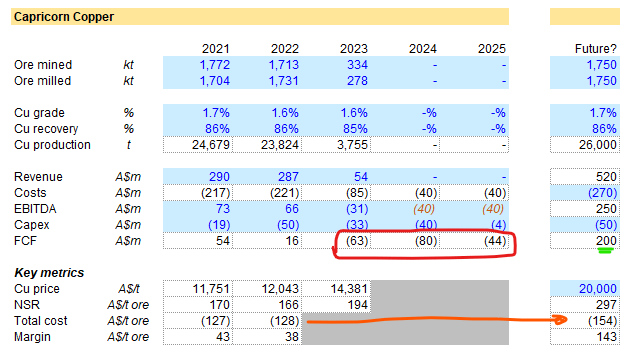
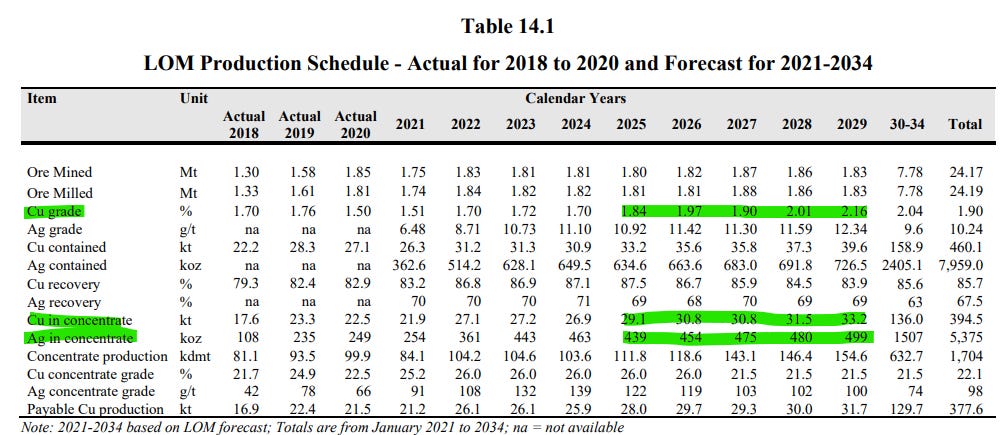
Should Capricorn go from being a ~$40m capital suck each year to contributing ~A$200m of FCF… it is clearly going to have a dramatic impact to the fortunes of 29 Metals. But getting to that state requires large amounts of time and capital that 29 Metals simply doesn’t have.. so what are their options? I’ll look to cover this in a later section that mentions the balance sheet.. but I’ll leave this Capricorn section by providing the LOM plan as per the IPO documents. Do note here that both copper and silver grades are expected to lift over the plan.. and that Capricorn - in addition to producing ~30ktpa of copper.. are expected to produce 400kozpa of silver.. which at today’s prices (~A$85/oz) is a cool ~A$30m pa (which is not accounted for in the above projections).
2. Golden Grove
In the past year we have seen the occurrence of a number of seismic events at mines throughout the world including at some of the worlds biggest copper mines like Cadia, El Teniente, Red Chris and Kamoa Kakula. In some cases these events have been fatal, and are a major risk in underground mining.
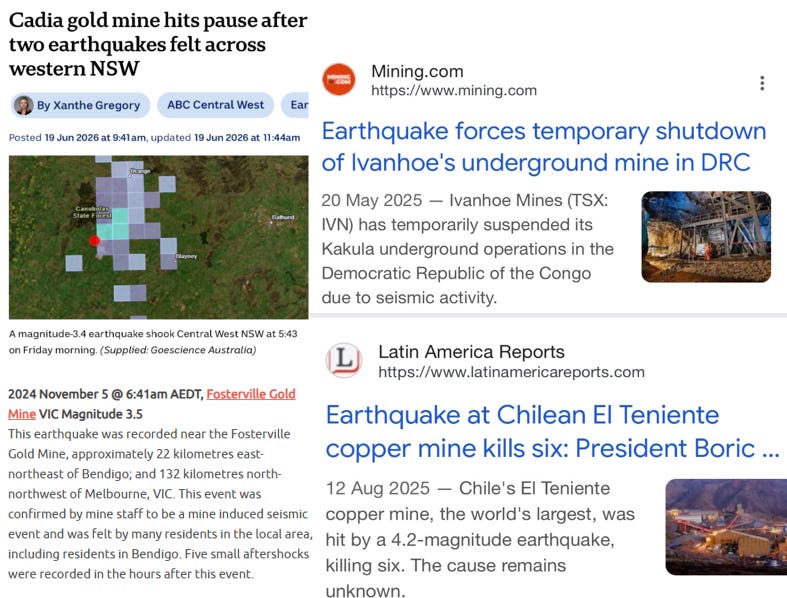
These events are not uncommon in deep underground mining - with rocks under extreme stress from the mass above. Rocks can move around… and the trigger can be natural (ie movement of tectonic plates) or more than likely mine induced (from moving rock through the use of explosives and extraction).
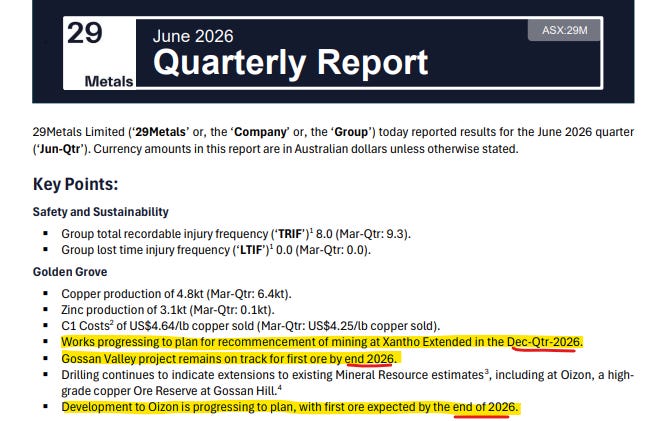
29 Metals Golden Grove mine has been hit by seismic events some three times in the past 18months - all at its highest grade and deepest deposit at Xantho Extended.. which sits some 1.7km below the surface. And after a few false starts on recommencing mining in this zone after such events.. the company decided in April this year to delay mining by a further ~6 months to enable the establishment of appropriate ground support and accessways to avoid further seismic interruptions in the future. This sent the stock tumbling >35%.
I’m no technical expert here.. I have observed mines close and never reopen post seismic events and I have observed mines get through and prosper post seismic events. The way I think about it (and again this could be completely the wrong thinking).. is like a Jenga tower - if you take out the wrong block.. the block that is the structural support with the highest stress... the tower is going to fall down. So you need to identify the points of stress (geotechnical experts do this) and avoid interactions with these zones as well as setting up mitigating infrastructure like ground support.

Can 29M and its geotechnical consultants successfully mine out the high grade ore at Xantho and avoid a repeat? I’ve no idea, I’d like to think so given the expertise plus time and capital spent now working on this.. but a risk of a repeat is there for sure.
What I think is a big mitigating factor here that generally isn’t available for many mines and I feel is being overlooked by the market… is that Golden Grove has 3 separate portals (completely different mining domains many kilometres apart) and over 7 different orebodies. And come December not only will they be back in mining at Xantho Extended (if all goes to plan) they would have opened up the Oizon and Golden Valley orebodies. This provides huge flexibility to mining and mitigates the risk of catastrophic loss in the event of further interruptions from seismic events.
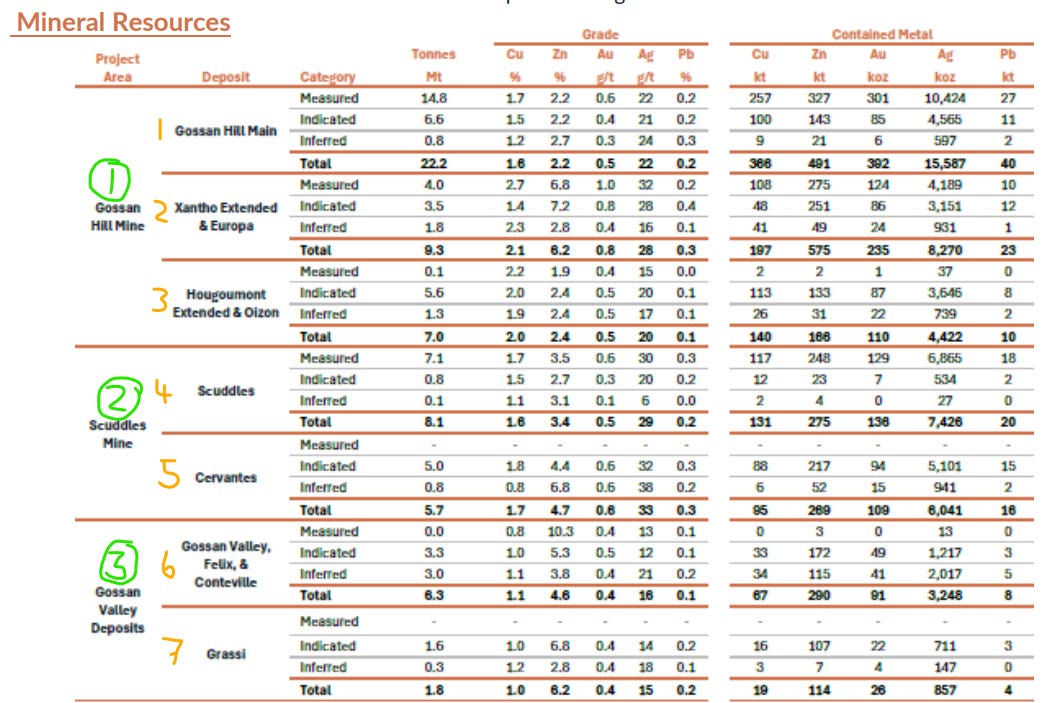
Why the stock got particularly hit on the seismic news was not only is Xantho one of the biggest orebodies (~9Mt out of a ~60Mt resource).. it is the highest grade and should be by far the highest margin. Per below - the Xantho rock is worth something like A$250/t more than the next highest value ore.
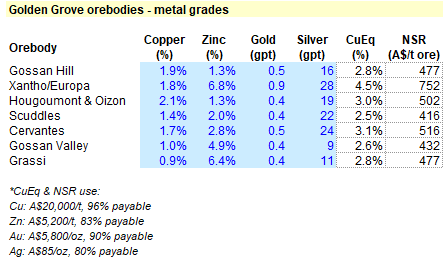
I would argue looking at the above though - that all orebodies have highly economic rock at todays prevailing metal prices given they are all >A$400/t NSR. But here’s the important caveat: so long as they can get the volumes out of the underground to utilise the capacity of the sunk infrastructure and absorb those fixed costs.
Even if you are conservative and say the site has costs of A$500m pa (vs closer to A$400m recently)… then so long as they are maximising the 1.8mtpa capacity unit costs are just ~A$280/t.. And if they only get out 1.55mtpa unit costs are ~A$320/t. This is well below the rock value of all of the orebodies. It’s only when volumes are down where they are at the moment (~1.2mtpa) that profitability turns negative… and it doesn’t help they are having to mine old low grade remnant ore stocks.
So like Capricorn - Golden Grove is a money pit at the moment given how far below capacity it is operating. They are in a catch22 situation - the operation cannot spit off cash without running near capacity and the operation cannot run near capacity without spending the time and capital tunnel boring to open up all these various orebodies. Mining is a fixed cost business and it is just too hard to cover fixed costs when volumes are so far below capacity.
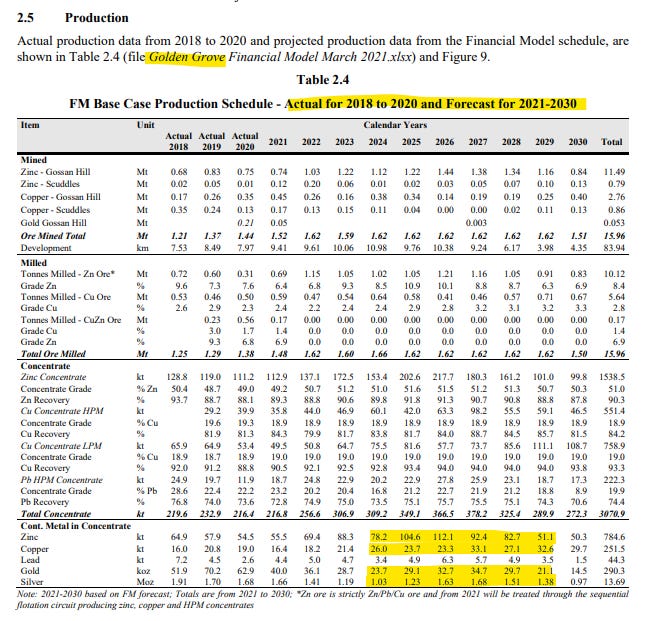
So again like Capricorn - Golden Grove needs capital to optimise its operations and return them to 2021 levels and I’ll look at funding options in a later section. I’ll leave you with the the LOM plan from the IPO and also the revenue mix for this operation.
Onerous contracts
So far we have covered two large impediments to 29 Metals being able to generate any cash flow recently…
the flooding event at their Capricorn Copper mine (and the costs to maintain this operation in a ready state) and
the seismic events at the highest grading orebody at their Golden Grove mine (and the capital costs to remediate this area in addition to opening up new ore sources).
But this hasn’t been the only cash flow impediment.
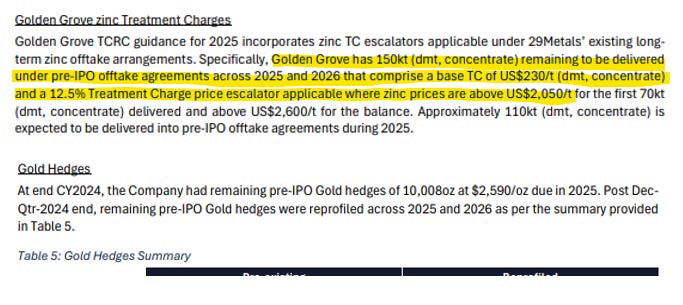
In a world scrambling for metal supply - smelter charges (TCRC’s) for concentrates of both copper and zinc have been at or near zero for some time. But this hasn’t been the case for 29M who has been trapped in a long dated pre-IPO offtake agreement with Trafigura for its Golden Grove zinc concentrates. You see not only is it paying US$230/t treatment charge (TC).. but it has an old offtake agreement that includes price participation. And so they effectively pay a 12.5% royalty when prices are over US$2,050/t. At today’s ~US$3,500/t zinc price and assuming ~100ktpa of zinc concentrates (50kt of Zinc).. 29M could be up for near A$50m pa (if it were producing that level of zinc). Note this contract is volume based and should be extinguished in the near future (next 12-24mths).
Additionally 29M is delivering into pre-IPO gold hedges at a price of A$2,590/oz (or ~US$1,800/oz!!). The hedge book was ~10kozpa so it was costing them ~A$30m in lost revenue - but this has stepped down now to 5kozpa and will be extinguished at the end of 2026.
Balance sheet
Financial leverage and private equity go hand in hand - that is the nature of the beast. And whilst I’m sure EMR used a good portion of the IPO proceeds to reduce their own debt - they still left a good chunk inside 29M at listing (~A$220m). Add some stamp duty payments and transaction fees from the IPO plus the onerous contracts mentioned above and it was highly levered.. especially for the operating leverage of the mines held by 29M (reasonably high cost) and the depressed metals markets at the time.
Anyone knows that combining financial leverage with operating leverage more often than not is a cocktail for disaster.. unless it’s one of those few occasions when underlying commodities rip and the added leverage juices the equity returns. But for 29M they were unable to survive through to todays hot commodity markets and thus have had to conduct not one but three highly dilutive equity raises that blew their share count from 500m at IPO to 1.75bn today (see the top for the list of raises). Even today the company continues to hold a large chunk of debt which is onerous for the company with various covenants that they need to abide by which restricts their use of capital.
So today 29M is in quite the predicament - they have debt they need to service (and covenants they need to abide by), they have onerous contracts they need to extinguish, they have the holding costs of Capricorn and they have the capital requirements to remediate the impacts of seismic events and mitigate future events by opening up additional ore sources at Golden Grove.
Solving the balance sheet
My modelling shows the companies existing ~A$180m cash balance will go a long way to turning Golden Grove around to be a decent cash generator in 2027 where it can not only self fund itself but service the company’s debt, onerous contracts and cover the Capricorn holding costs. BUT - they have very little buffer for any unforeseen interruptions… AND - the debt is extremely restrictive - just look at these covenants (including the need to hold a minimum US$30m of cash). 29M was forced to do a dilutive equity raise in January given a breach of covenant/s.
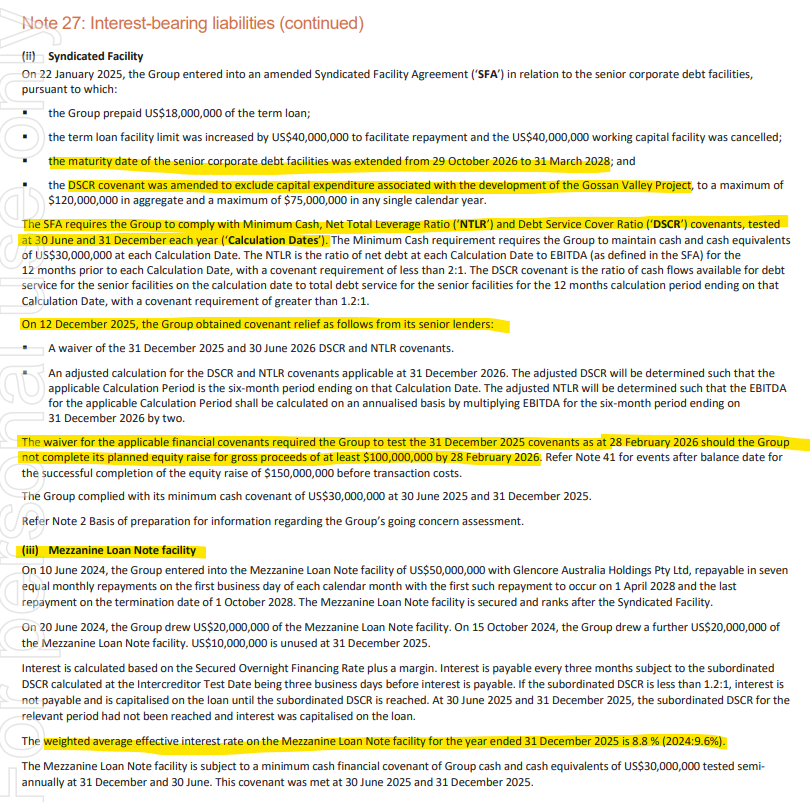
In my view 29M need to raise at least A$250m.. A$200m to clear the existing debt (removing the restrictive covenants) and A$50m+ as a working capital buffer. This is before we look at funding a Capricorn restart.
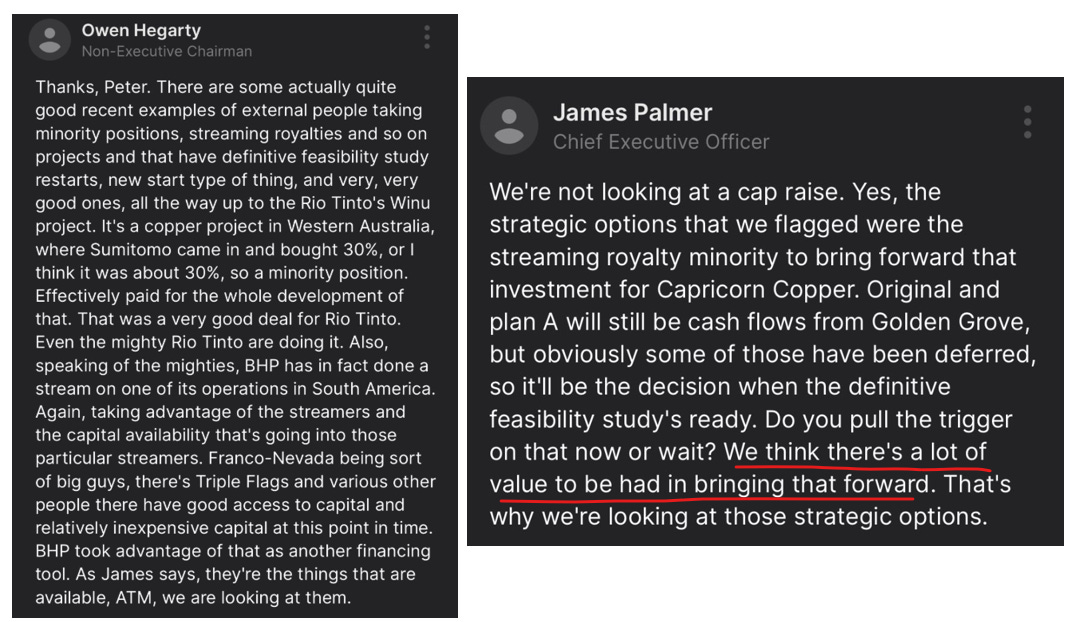
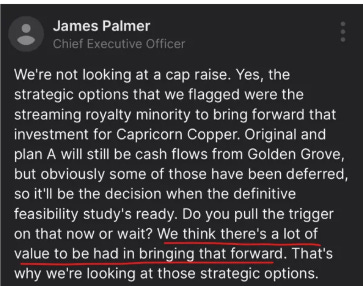
What are their options? Well the company has ruled out an equity raise - and with the equity trading at a 90% discount to the IPO price and so far below NAV.. that’s not surprising. Asset sell downs could become a viable option but in my mind there is only one (or two) option… sink or stream.
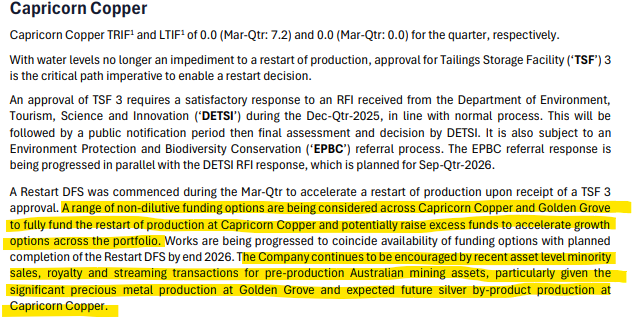
Don’t take it from me, here’s what management had to say at its most recent AGM and an extract from last weeks quarterly report.
Stream Finance
For those who don’t know about stream finance I’ll let you do your own research.. all I’ll say is it has become a critical source of funding for the mining sector given its favourable properties and streamers have some of the lowest cost of capital available in the sector. Not only will stream finance likely be cheaper than the ~9% costing debt 29M has already but it will come with far less restrictions of use (no covenant testing etc). The catch is you have to give up some of your precious metal revenue for typically the life of the mine, but all things considered this isn’t the worst trade off for someone in 29M’s position.
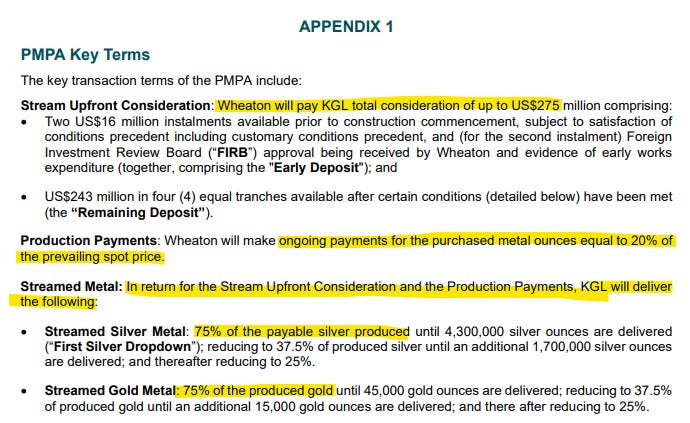
How much can they raise? I’ll point to one recent deal to give an indication - which is the KGL (KGL.AX) deal with Wheaton back in April. The basics of this deal was Wheaton provided KGL with US$275m of upfront capital (A$400m) in return for effectively 60% of their precious metals revenue (they pay 20% of spot on 75% of volume = 60%).
KGL has an 8 year mine life where they expect to produce 1.5Mozpa of silver equivalent. At spot pricing of A$85/oz they are returning to Wheaton A$77m per year in precious metal revenue for the first ~8years after which it steps down to around A$5m. So Wheaton should receive ~A$600m over the existing mine life (plus a kicker if the mine life extends)
Recall above that my modelling above suggests that once optimised Golden Grove could be generating some ~A$300m pa of free cash flow… and that there is some ~A$156m of precious metal revenue (~1.8Mozpa AgEq). This estimate is well below the IPO LOM plan by the way.
In my mind if Golden Grove were to give away 25% of its precious metals revenue (~A$40m pa) this is going to have very little impact to the profitability of an optimised operation. And based on the KGL deal they may receive something in the order of A$300m in return (more than enough capital to optimise the operation).
And finally on Capricorn. They have A$30m pa in silver revenue as I showed above. And this really is all pure margin (not required to operate profitably). So potentially a further A$200m available here.. (likely comes once permits and FID is completed).
The Trade Set up
In front of 29M is a solid 6-9months of fairly heavy cash burn and execution risk. Normally I’d step aside for this period and wait for clear signs of de-risking and an inflection point before taking a position. But the risk of trying to be too cute with timing here is I think there is high probability the company can execute a funding solution in the near term… and this may leave the folks on the side-lines scrambling for position.. and I don’t wish to be one of those.
With the company flagging the trigger is likely to be pulled on a deal sooner than later (see below)… and a strong likelihood they will breach the DSCR covenant when the 30-Jun audited accounts get published late August… I think they will execute a funding agreement soon (in the next month). And at this point I don’t know how that funding deal is anything but good.
So I am not trying to get too cute with the timing and am hoping that a funding deal will be the catalyst to take this thing from trading at ~10% of NPV to something closer to 30% of NPV.
Summary
Mining throws up many challenges - no more than Mother Nature herself. 29 Metals has encountered the wrath of Mother Nature at their copper operations in the past couple of years. Those interruptions combined with having to extinguish legacy onerous contracts and having finite amounts of capital has meant 29 Metals has not been in a position to take advantage of today’s extremely strong metals markets. In fact they have torched capital at a rate of knots trying to remedy their situation which has left shareholders with a very sour taste in their mouth.
If the company can solve for their current capital constraint and execute on returning operations back to a state they were prior to the interruptions from Mother Nature I think the upside here for shareholders is truly incredible.. especially with metals such as copper approaching all time highs.
My modelling suggests the optimised operations could generate something in the order of A$500m margin per year.. and that the shares could be trading as low as 10% of NAV. But there is a lot of time and money and solid execution required to extract full value from the 29M Asset base.
This is an extremely high risk speculation and I wouldn’t recommend it to anyone.. so please do your own due diligence and consult an adviser.. I am just a degenerate gambler.
Love to hear your thoughts
Respeculator
Thanks for the write up. Really appreciate your time and analysis. I went to the AGM and asked the question on the cap raise you quoted. I also spoke to them about what they had done about the flooding at Capricorn and they have put in diversion infrastructure that has dramatically reduced the risk of a recurrence on top of the treatment and dewatering infrastructure.
It seems to me that the problems are well defined and solutions are understood.
Thanks for the detailed write up, i love in-depth analysis. Respeculator for president ;)